
Developers are often the highest-paid people at marketing agencies. The profession stays in high demand, and salaries change annually based on market conditions. We think 2026 will be no different. If you are running a new agency or thinking about expanding an established one, our overview of 2026 developer rates might help with planning.
We talk with tens of agencies from the US every day, and developer costs come up regularly in these conversations. Based on what we hear, we will try to give you an idea of what rates to expect for 2026.
Analyzing web developer salary trends (2015–2026)
Web developer salaries have climbed steadily over the past decade. In 2015, the median annual wage sat at $64,970 according to Bureau of Labor Statistics data. By May 2024, that number reached $90,930, a 40% increase over nine years.
The shift in developer market rates
The growth was not linear, though. Between 2015 and 2019, salaries increased moderately, averaging around three to four percent annually. Then COVID-19 hit, and the market shifted. Remote work quickly became standard, which changed how companies hired developers.
Before 2020, most agencies competed for local talent. A Chicago agency hired from the Chicago market, paying Chicago rates. After 2020, that same agency started competing with San Francisco companies for remote workers.
This pushed rates up, not down, because developers now had access to higher-paying opportunities. A developer in Chicago who previously could only apply to local jobs paying $75,000 could suddenly apply to San Francisco-based remote positions paying $120,000. To keep that Chicago developer, the local agency had to raise their offer closer to what the San Francisco company was willing to pay.
The competition moved upward toward the highest-paying markets rather than downward toward the lowest. Developers gained leverage because they could now choose from a national pool of jobs, and agencies in expensive markets were already used to paying premium rates.
Current benchmarks
Fast forward to today, let’s look at the web developer salary trends for 2026. To do this, we analyzed developer salaries across major employment platforms like Glassdoor, Indeed, and others. Here is a quick look at how the market looks right now:
| Source | Median or Average Salary | Typical Range |
| Bureau of Labor Statistics | $90,930 | – |
| PayScale | $70,705 | $49,000-$100,000 |
| Glassdoor | $99,893 | $76,723-$131,243 |
| ZipRecruiter | $93,848 | $72,000-$113,500 |
| Indeed | $82,236 | – |
From this table, we can probably conclude that a reasonable planning number for an experienced web developer in 2026 sits around $85,000-$95,000 annually. Entry-level developers do cost less, though. But you should always consider the trade-offs. Junior developers require more oversight, produce slower work initially, and need mentorship that pulls time from experienced team members.
For WordPress-specific developers, the numbers shift slightly lower. ZipRecruiter reports WordPress developer salaries averaging $84,542 annually, with most positions ranging between $60,500 and $99,500.
The real cost of hiring a web developer for an agency

When we are discussing salaries, we also need to consider that base remuneration is only part of what hiring actually costs. The remaining 30-40% comes from mandatory taxes, benefits, and operational expenses that add up quickly.
This is what experts call the “fully loaded costs”. For example, the Small Business Administration notes that employee costs typically run 1.25 to 1.4 times the base salary. So a $90,000 developer salary translates to around $112,500-$126,000 in total annual cost.
Here is where that extra cost comes from:
Mandatory taxes and insurance
- Federal unemployment tax: $42 per employee
- Social Security and Medicare: 7.65% of salary ($6,885 on a $90,000 salary)
- State unemployment insurance: varies from 0.5% to 14% depending on your state
- Workers’ compensation: typically 0.5-3% for office workers
Benefits
- Health insurance: $7,500-$11,000 for individual coverage, or $15,000-$23,000 for family plans (employers usually cover 70-80%)
- 401(k) matching: most companies match 3-6% of salary
- Paid time off: two weeks vacation plus federal holidays means paying for roughly 18 days when the employee is not working
Equipment and workspace
- Computer and monitors: $1,800-$3,300
- Software licenses: varies based on tools needed
- Office space: if you maintain physical workspace
So that $90,000 salary becomes around $125,000 before you factor in office costs or equipment. This is the 1.4x multiplier people reference when talking about “fully loaded” costs.
Time investment beyond money
Another thing to consider is how much time hiring actually takes. Recruitment alone eats up 20-40 hours: writing job descriptions, screening resumes, conducting interviews, checking references, negotiating offers. It’s estimated that the average recruiting and onboarding cost sits around $4,000. However, this is just an estimate, and costs may vary significantly.
Then comes onboarding. It would be fair to say that even experienced developers need two to four weeks to learn your workflows, how you communicate with clients, your coding standards, and whatever project management tools you use. During this period, they may not be producing much billable work either.
After that, you also need to consider that daily management will become part of your routine. Developers need project assignments, check-ins on progress, help with complex problems, code reviews, and coordination with clients. This may pull you away from bringing in new clients and working on a bigger-picture strategy.
We have noticed that some founders genuinely enjoy managing people. Others find it exhausting and realize they built a job they never actually wanted. It might be worth thinking honestly about which type you are before committing to hiring.
Scaling a marketing agency with white-label developers

Traditional hiring is not the only path to scaling, though. For example, white-label partnerships offer a different model. Let’s explain how.
Pay for development only when you need it
An in-house developer represents a fixed cost. Whether you have two projects or 20 projects this month, that $90,000 salary plus benefits remains constant. In other words, this may mean that you are paying for 160 hours per month regardless of actual workload.
This creates two problems. During slower months, you are paying for unused capacity. During busy months, you are capped at one person’s output.
A white-label partnership converts this to a variable cost aligned with actual project volume. You pay for the development hours you need each month, which might be 40 hours one month and 200 hours the next month.
Projects
Outsource WordPress projects with confidence. We provide fixed-price white-label development and dedicated management with no upfront payment.
We work with agencies that love this flexibility. When a big client launches a site redesign, they scale up. When summer hits and client work slows down, they scale down. Their development costs match their revenue, which makes cash flow management easier.
Some agencies maintain a hybrid model. They hire one developer for predictable ongoing work, then use white-label partners for overflow projects and specialized work.
WLA developer rates
If this scalable model is a good fit for you, feel free to check out our dedicated developer rates.
The right person for every task
A single hire gives you one person’s skill set. Maybe they are strong in front-end development but weak in WooCommerce customization. If that’s the case, you are limited by that individual’s specific strengths and weaknesses.
On the other hand, a specialized WordPress team can give you access to multiple developers with different expertise areas. At WLA, we have developers who focus on WooCommerce, others who specialize in custom development, designers who understand WordPress-specific design constraints, and specialists who optimize site speed.
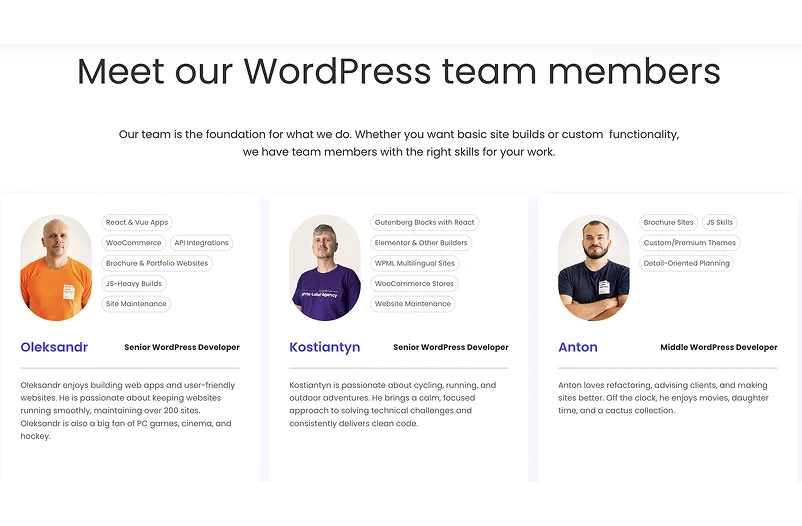
This matters when client needs vary. One project requires complex membership functionality. Another needs a multilingual site setup. A third involves payment gateway integration. With a single developer, it’s unlikely that their skill set matches each new requirement. With a team, you get matched with the right specialist for each project.
Wrap up: web development hiring vs. outsourcing
The decision between hiring and scaling a marketing agency with white-label dev comes down to your specific goals and budget.
If you have consistent project volume, enjoy team management, and can absorb the $112,000-$126,000 annual investment, including the time costs, hiring might align with your vision. But if you value flexibility and want to minimize overhead, a white-label partnership deserves consideration.
Many successful agencies use a hybrid approach. They might hire an account manager or project coordinator while outsourcing technical development. Or they bring one developer in-house for core work while using partners for specialized projects and overflow capacity.
At WLA, we work with 600+ digital agencies producing 3,000+ websites annually. If you want to explore whether a white-label partnership fits your agency’s specific situation, reach out to our team. We can discuss your current workflow and growth plans to see if this model aligns with where you want to take your business.