


The customer only cares about the end product. What happens behind closed doors, remains a mystery and (most of the time) stays there. In this article, we are going to discuss the concept of white labeling in general, talk about its advantages, and highlight white label websites in particular.
Have you ever wondered how hard it is to write a book? How long does it take to finish, and how many drafts are necessary to produce before finally publishing it? Well, it’s not a cakewalk. But sometimes we go to a bookshop or a library and we see books on the shelves written by famous individuals like athletes, politicians, and actors, and wonder: “I never knew this guy could write.” Well, you’re right to wonder. Many never were writers and never had the time or ability to write. They hire someone else to do their job.
We know those people as ghostwriters. They listen to the story of an “author”, then sit down and write hundreds of pages about them. However, on the cover, we never see the name of a ghostwriter written on it, because they don’t get the credit for it.
Now, why are we talking about ghostwriters?
To understand the concept of white labeling.
What are white label products?
White label products are manufactured by a third party but the products themselves are sold by retailers with their own branding and logo. White label companies, like ghostwriters, don’t get credit for the products they create.
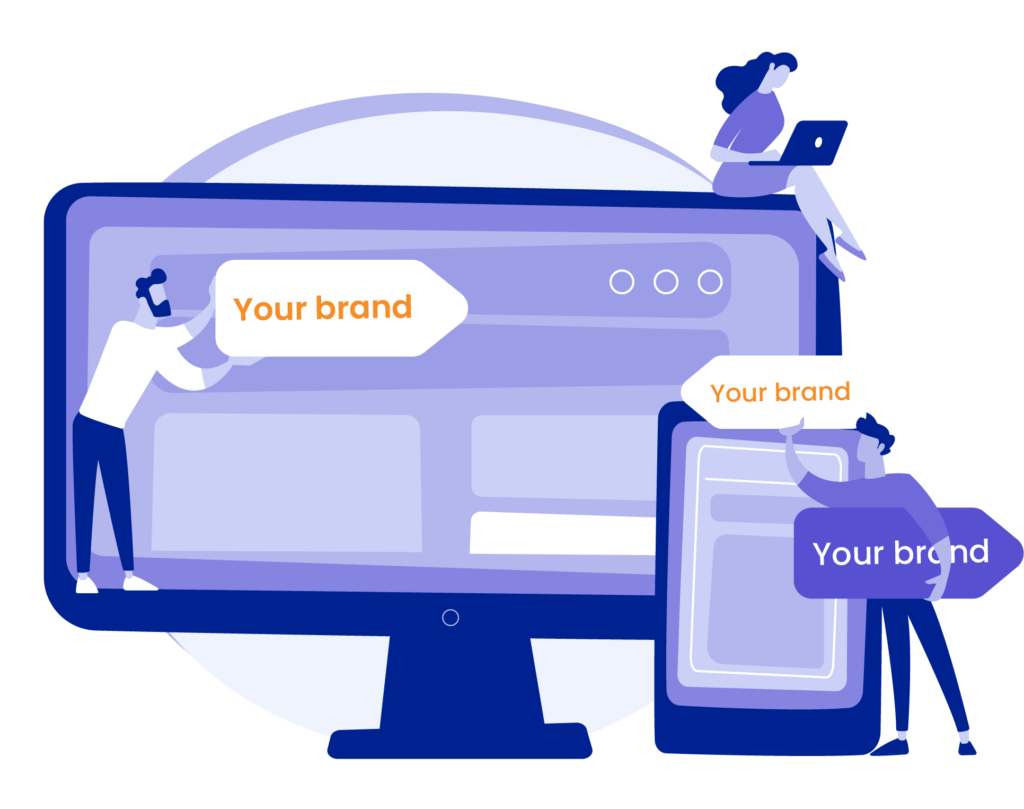
The advantage of white labeling is that a single company or a group of people does not have to go through an entire process of creating or selling the product, but they get the credit anyways. This is the key contrast with simply freelancing or outsourcing–with these arrangements, others do part of the work, but they get credit for their part. If it’s important for your agency’s reputation or relationship with clients to have your brand on the product, white labeling may be a better way to go.
White label website
White label products are not always material items. In the modern-day digital world, services have increasingly been offered under white label arrangements too. Now that we know the general concept of white label products, guessing what a white label website might be is quite easy: a website built by a third party.
There are a range of different white label services you can enlist as part of building websites. You may want to develop a website from scratch, fix some bugs, or update WordPress plugins. You may want to hire a dedicated developer or acquire maintenance services. White label agencies can provide different services that match your needs. They can provide temporary resources in periods when you have more work than developers have time, or long-term arrangements to facilitate scaling and focusing on sales.
White labeling can offer many benefits, but it’s important to consider the potential drawbacks as well. One potential disadvantage is the lack of control over the project. When you white label a website, you are essentially handing over a project that represents you and your brand identity to another agency.
Outsourcing can also mean that different developers work on different projects, which can result in differing levels of quality. Communication can also be a challenge, particularly when outsourcing to developers in different time zones or with poor language skills. While these challenges can be managed with careful planning and communication, it’s important to consider them before deciding whether white labeling is right for your business.
Despite these challenges, website development via white label agencies can be a solution to a number of problems companies or individuals face. It is not necessary to hire staff when someone else can guarantee the result with your own brand name on it. It can also be more economical.
White Label Web Design
Maximize your agency’s potential with our white label web design services. Deliver high-quality, branded websites without the need for an in-house team.
Advantages of white label website
Hiring a group of designers and developers to create a website can be expensive, so the white label approach can come in handy. You run a small business and the website is a crucial part of showing your potential and upscaling the job you do, – no need to look for professionals individually and locally.
Entrust your vision to the agency that will do everything for you. This means that you, as a purchaser, are doing several things at the same time – saving money, time, and the headache of unforeseen events that happen during recruiting.
Developers are a fast-growing group of people who change their opinions and work sites pretty quickly, so it can be more reliable to leave your job to an agency with several developers ready to start coding.
So, why choose white label rather than hiring a freelancer or any other outsourcing company?
There are several factors that differentiate ordinary outsourcing and a great white label agency. When you decide to outsource some of your projects, you have options to hire freelancers or agencies that may help you carry the burden, however, white labeling with the right agency offers you several advantages:
- You keep the credit for the completed task.
- You get professionals with years of experience and knowledge – for example, WLA has 100+ developers specialized in building WordPress websites, also 3,000 WordPress projects delivered and managed per year.
- Focus on core competencies: By outsourcing website development, you can free up your team’s time to focus on your core competencies, such as marketing or sales
- You get fixed-priced quotes for the services, which allows you to arrange your economic plans accordingly.
As mentioned above, the main advantage is credit. You keep your own logo on the product, while work is done by a third party. Another main factor is time and expertise: Hiring an in-house developer requires too much time and resources. First, the selection process can be tough. Then, training takes time, and adaptation of the new co-worker may take several weeks or even months. Even the freelancer, they’ve usually worked on diverse projects and their focus may be oriented toward different aspects of development.
Managing the freelancer to adapt to your client’s needs is a challenge, while white label developers are used to receiving a wide range of tasks with different requirements. This is certainly the case with the White Label Agency’s developers as the agency has 10 years of experience in the business. Handing your projects over to an agency with the collective experience of hundreds of developers and many years working with WordPress gives you the possibility to save time, money, and resources.
However, every medal has two sides. There can always be concerns about many things when you’re outsourcing your business. Probably one of the biggest concerns with white labeling is the quality and consistency of products. When you have your brand established and have a niche and a certain way of doing things, you have faith that an outsourced agency will follow it. Keeping and maintaining control over this can be tough.
The option that the White Label Agency can offer is communication. Starting point is capturing the identity and insights about you. Renting a developer is also a viable option, as he/she can learn about the company’s core values and preferences in order to provide effective solutions. So it is vital that you brief the agency with simplicity and with the smallest details, because as they say: the devil is in the details.
So how do you maintain communication despite the distance?

Maintaining quality, control & communication
Today, online communication has become quite ordinary. The White Label Agency adapts to the communication channels of your choice in different ways: like regular online meetings, different apps, emails, etc. After that, the process begins.
In the end, human beings only trust themselves, of course, there are some exceptions, but let’s not talk about that. So what is the guarantee that the white label approach can be effective and provide results that should be expected?
In the beginning, there was the word, so it’s safe to say that trust comes with words – meaning communication. Even if you have trust issues, there’s nothing to worry about. The objective of the White Label Agency’s approach is for everyone to be on the same page.
Using digital communication channels, project management tools, and technical software that are shared and understood by the members working on the same project can quite easily overcome any barriers and difficulties. Look out for a white label approach that has a project manager attached to each project. This will help ensure that the developer meets the deadlines set by you, that the quality is high, and that the project progresses as intended.
Communication continues with occasional feedback that gains trust and in the best-case scenario maintains it. The main concern while outsourcing is the quality of the task. And it is very understandable. The people working on your project are people whom you have not even met in person.
However, the white label agency has a quality assurance team that checks the site before the result is shown to the partners. And after performing a full review, the developer starts making fixes of your choice straightaway until the result is perfectly acceptable.
To sum it all up, the white label approach offers multiple solutions all at once. It saves lots of energy, time, and money. White label website has easy to use admin panel according to technical specifications under the brand and logo of the purchaser.
May you find your own ghostwriter, who does everything for the product of your dreams, by maintaining full rights and the logo of your choice written on it.
Ready to take your business to the next level with a reliable partner? Contact us today to discover how The White Label Agency can be your silent partner in success.
FAQs
What does “white label” mean?
“White label” refers to a business model where one company creates a product or service that other companies can rebrand as their own. In the digital world, white labeling allows businesses to offer services like website development, maintenance, or even eCommerce platforms without creating them from scratch. Instead, they partner with a provider who has already developed the solution, saving time and resources.
What is an example of a white label brand?
An example of a white label brand is private-label grocery items, like store-brand pasta or snacks, commonly found at major supermarkets. Retailers such as Walmart or Target sell products like Great Value or Up & Up, which are made by third-party manufacturers but rebranded and sold under the retailer’s label.
In the digital space, white label services are often seen in software. For example, a marketing agency might use a white label email marketing platform that allows them to offer email services under their brand without developing the software themselves.
What is grey Labelling vs white Labelling?
Grey labeling is a variation of white labeling where the original provider’s branding is subtly present alongside the reseller’s branding. Instead of fully rebranding the product or service as the reseller’s own (as in white labeling), grey labeling may show some hints or mentions of the original provider, either through small logos, disclaimers, or co-branding elements.
Here’s a breakdown:
White Labeling: The reseller completely rebrands the product or service, with no visible trace of the original provider. The end-user interacts only with the reseller’s brand.
Grey Labeling: The reseller rebrands most of the product or service but leaves subtle references to the original provider. This approach is common when full rebranding isn’t feasible or when transparency about the product’s origin adds credibility.
Each model suits different goals. White labeling works well for businesses wanting full brand ownership, while grey labeling is useful when both brands benefit from shared recognition.
Is white labeling legal?
Yes, white labeling is completely legal. It’s a standard business model used across various industries, provided both parties follow the terms of their agreement. In a white-label arrangement, the manufacturer or service provider gives permission to the reseller to rebrand and sell the product or service as their own.
Contracts typically outline guidelines on usage, branding, and responsibilities, ensuring legal compliance for both the provider and the reseller.
In fact, white labeling can be mutually beneficial: it allows resellers to expand their offerings quickly, while providers reach a broader audience through partnerships.
What is white label in eCommerce?
White label in eCommerce is a business model where a company sells products manufactured by another company under its own brand name. This means the eCommerce business doesn’t need to handle manufacturing or product development; instead, it focuses on branding, marketing, and sales.
What Is White Label WordPress Maintenance?
White Label WordPress Maintenance is a service provided by a third-party company that handles the ongoing upkeep, updates, and optimization of WordPress websites on behalf of another business, such as an agency, under that business’s branding. The service is entirely rebranded, so the end client sees the maintenance as being provided directly by the agency, not the third-party provider.


