- What is White Labeling?
- How White Labeling Works
- Comparing White Labeling, Private Labeling, and OEM
- When to Use Each Approach
- 3 Benefits & Advantages of White Labeling
- Challenges & Risks of White Labeling (And Their Solutions)
- Getting Started with White Labeling in 6 Steps
- Projects
- Industry Applications & Real-World Examples
- Woocommerce Developer
- Special Focus: White Label WordPress Development & Design
- Summary
Businesses are constantly seeking ways to expand their offerings without incurring the high costs and lengthy timelines associated with developing products or services from scratch. One increasingly popular strategy is the white label method.
This guide will explore every aspect of white labeling—from its core definition and historical evolution to its unique components and how it differentiates from similar models like private labeling and OEM. Whether you’re a digital agency, retailer, or service provider, understanding white label meaning can help you leverage existing products and services under your own brand, driving efficiency and growth.
What is White Labeling?

White labeling is a business practice where one company produces a product or service, and another company rebrands and sells it as its own. This allows businesses to offer high-quality solutions without the need for in-house production, instead relying on a third-party provider for fulfillment.
Common examples of white labeling include:
- Supermarket-branded food items manufactured by third-party companies.
- Digital marketing agencies offering white label SEO services through an invisible white label provider.
- Software companies reselling white label SaaS platforms under their brand name.
This model enables businesses to focus on branding, marketing, and customer relationships while leaving production and service delivery to specialized providers.
A Brief History of White Labeling
The concept of white labeling has evolved over time, initially emerging in the retail sector where supermarkets and department stores sought to offer their own branded versions of generic products. Over the years, the model expanded into various industries, especially with the rise of digital commerce and software development.
With globalization and the internet, white labeling has become a dominant strategy for businesses looking to scale quickly without incurring significant manufacturing or development costs. Today, it’s particularly prevalent in SaaS (Software as a Service), fintech, e-commerce, and digital marketing.
Common Misconceptions About What Is a White Label Product
While white labeling is a popular business model, it is often confused with private labeling and OEM manufacturing. Here’s how they differ:
- White Labeling: The same product or service is sold to multiple brands, who rebrand it as their own.
- Private Labeling: A product is customized for a single brand and not shared with competitors.
- OEM (Original Equipment Manufacturer): A company manufactures a product according to a client’s specifications, often with full customization and branding exclusivity.
Understanding these distinctions is crucial for businesses choosing the right approach for their needs.
How White Labeling Works

As we have explored what is white labeling, it’s time to look at how it actually works in practice. White labeling operates on a straightforward yet highly effective business-to-business (B2B) model. A manufacturer or service provider produces a generic product or service and sells it to another business, which then rebrands it as its own before offering it to customers.
The process typically follows these 4 steps:
- A third-party provider creates a product or service – This could be a tangible item, software, or even a digital marketing solution.
- A company purchases the product/service under a white label agreement – The purchasing company can customize certain elements, such as branding and packaging.
- Rebranding and selling under a new identity – The company markets the product/service as its own, targeting its specific audience without revealing the original provider.
- Customer experience remains seamless – From a buyer’s perspective, the product or service appears to come directly from the brand they trust, reinforcing brand loyalty.
This model is particularly advantageous for companies looking to scale quickly without the overhead of research, development, and production.
4 Essential Elements of White Labeling
For white labeling to be successful, several key components must be in place:
- Unbranded or Generic Base Products/Services – White-label offerings start as unbranded solutions that can be easily customized to match a business’s identity.
- Customization & Branding Options – While white label products/services are not fully bespoke, companies often have the ability to add their logos, brand colors, and packaging.
- Strong Supplier Relationships – Because companies depend on external providers, ensuring consistent quality and reliability is essential.
- Scalability & Distribution – White labeling enables businesses to expand product lines and enter new markets without significant operational adjustments.
Comparing White Labeling, Private Labeling, and OEM
While white labeling, private labeling, and OEM (Original Equipment Manufacturing) all involve outsourcing production, they differ in several key ways.
| Feature | White Labeling | Private Labeling | OEM (Original Equipment Manufacturer) |
| Customization | Limited (Branding only) | Moderate (Some product variations) | Full customization based on client specifications |
| Exclusivity | Non-exclusive; the same product/service can be sold to multiple companies | Exclusive to one brand | Exclusive and fully tailored |
| Control Over Production | Low – relies on third-party providers | Medium – some input in production | High – complete control over production details |
| Speed to Market | Fast – products/services are ready-made | Moderate – requires some development time | Slow – full customization takes longer |
| Cost | Lower – no R&D or manufacturing costs | Medium – some development investment needed | Higher – full product development and production costs |
When to Use Each Approach
Each model serves different business goals, and choosing the right one depends on factors such as brand positioning, budget, and long-term strategy.
- White Labeling: Ideal for businesses that want to quickly expand their offerings without developing new products from scratch. Best for SaaS companies, digital agencies, financial services, and retail brands.
- Private Labeling: Suitable for companies looking for a balance between product differentiation and affordability, such as cosmetics, supplements, and apparel brands.
- OEM Manufacturing: Best for businesses that need fully custom products, such as automotive, electronics, and high-end consumer goods.
3 Benefits & Advantages of White Labeling
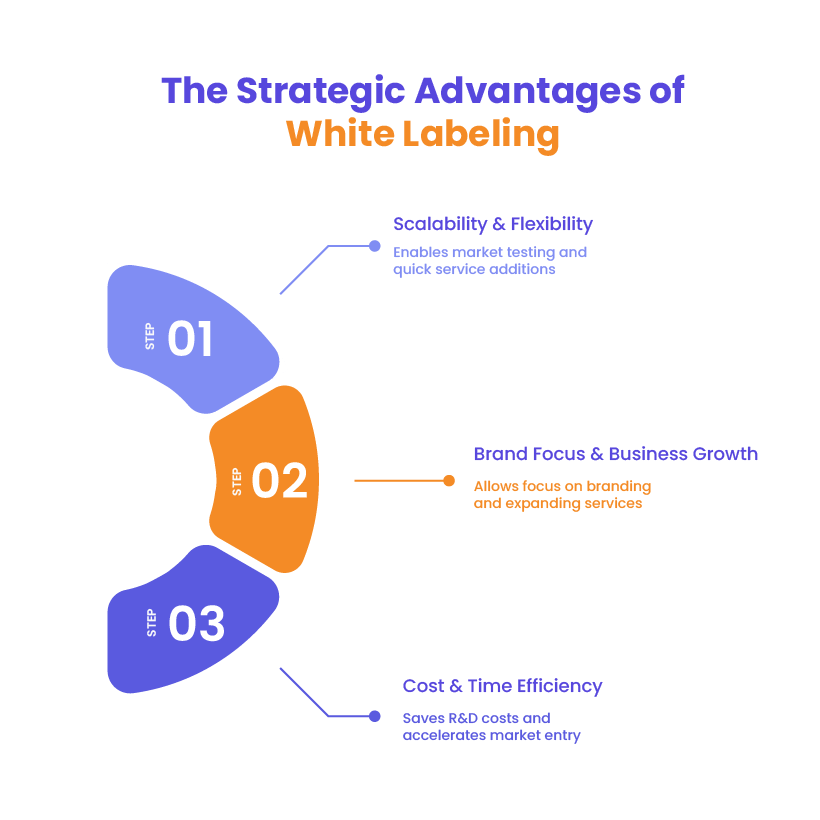
White labeling offers numerous advantages for businesses looking to scale quickly and efficiently without the overhead of production or service development. Whether in e-commerce, SaaS, or digital marketing, companies leveraging white label solutions gain a competitive edge.
1. Cost & Time Efficiency
One of the biggest benefits of white-label solutions is their ability to save businesses both time and money. Instead of investing in product development, research, and manufacturing, companies can:
- Avoid high R&D costs – No need to create a product from scratch.
- Enter the market faster – White label services/products are already developed and tested.
- Reduce operational expenses – No need for a dedicated production team.
For businesses looking to launch new offerings without the risks of in-house development, white label products provide a cost-effective alternative.
2. Brand Focus & Business Growth
Rather than spending resources on creating new products, businesses can focus on branding, marketing, and customer engagement. With white label marketing, companies can:
- Expand their service offerings without the need for expertise in multiple fields.
- Build brand authority by offering professional-grade products/services under their name.
- Scale quickly by integrating white label solutions into their existing business model.
For example, a digital agency specializing in design can also offer white label content creation without hiring an in-house team. This expands the agency’s service list while maintaining a strong brand identity.
3. Scalability & Flexibility
A key advantage of white labeling is its scalability. Businesses can expand their product or service offerings without significant investment, allowing them to:
- Test new markets with minimal financial risk.
- Quickly add new service lines by partnering with a reliable white-label provider.
- Adapt to changing customer demands by integrating new services effortlessly.
For example, marketing agencies can offer additional services like white label web design without hiring additional staff.
Challenges & Risks of White Labeling (And Their Solutions)

While white labeling offers significant advantages, businesses must also navigate certain challenges and risks to ensure a successful implementation.
Quality Control & Brand Reputation
One of the biggest risks of white labeling is maintaining consistent product/service quality. Since businesses rely on third-party providers, potential issues include:
- Varying service standards – Not all providers uphold the same level of quality.
- Customer dissatisfaction – Poor-quality white-label services can damage a brand’s reputation.
Solution
Companies should vet their service providers carefully, request case studies, and establish strict quality control standards before finalizing agreements.
Dependence on Suppliers
Another risk of white label solutions is over-reliance on external suppliers. If a provider experiences delays, service issues, or goes out of business, companies face:
- Service disruptions
- Difficulty switching providers quickly
Solution
To minimize risks, businesses should diversify their supplier base, negotiate clear service-level agreements (SLAs), and have contingency plans in place.
Limited Customization Options
Unlike OEM manufacturing or private labeling, white label products often have limited customization. Companies may struggle with:
- Brand differentiation – Since multiple businesses may sell the same white-labeled product, standing out can be challenging.
- Customization constraints – Some white-label providers allow only minor branding modifications.
Solution
Businesses should focus on strong branding, exceptional marketing, and superior customer service to differentiate their white-labeled products from competitors.
Legal & Contractual Considerations
Using white label services involves legal and contractual considerations, including:
- Intellectual property (IP) rights – Some providers retain ownership of the product, limiting branding flexibility.
- Confidentiality risks – Since providers may work with multiple companies, sensitive business information could be at risk. Implementing a Non-Disclosure Agreement (NDA) is essential to ensure proprietary strategies, customer data, and business operations remain protected.
- Compliance with industry regulations – Certain white label solutions must adhere to legal and regulatory standards (e.g., healthcare, finance, or digital services).
Solution
Before entering a white label agreement, businesses should:
- Ensure compliance with relevant industry regulations.
- Review contracts carefully to ensure fair terms.
- Clarify intellectual property rights and exclusivity agreements.
Getting Started with White Labeling in 6 Steps

Transitioning from our discussion on what is a white label product and overcoming the challenges associated with this business model, it’s time to transform strategy into action. With the obstacles clearly identified and mitigated, this step-by-step guide will help you implement a robust white-label solution that aligns with your business objectives.
Let’s dive into a process that empowers you to leverage existing products and services while reinforcing your brand identity.
Step 1: Identify Market Opportunities
Before you proceed, it’s essential to clarify what does white label mean for your business. Begin by:
- Analyzing Market Trends: Examine industry data and customer feedback to identify gaps where white label products can satisfy emerging needs.
- Assessing Customer Demands: Determine if your audience is seeking additional services or products that can be quickly launched using a white label strategy.
- Evaluating Competitive Positioning: Consider how your competitors are expanding their offerings. Use these insights to pinpoint areas where you can differentiate your brand through white label solutions.
Step 2: Select the Right Partner
The success of your white-labelling initiative heavily relies on choosing a reliable partner. To ensure alignment with your brand values and quality standards, consider the following:
- Expertise & Reputation: Look for providers with a strong track record. Whether you’re exploring white label WordPress development or other services, experience matters.
- Quality Assurance: Verify that the partner maintains high quality and consistency. This is crucial for reinforcing white label meaning as synonymous with reliability in your market.
- Flexibility in Customization: Ensure that the provider offers sufficient customization options so that your branding—such as logos, color schemes, and packaging—remains unique.
- Clear Communication: Establish transparent channels for ongoing communication. This makes it easier to address any issues quickly and maintain a seamless workflow.
Projects
Outsource WordPress projects with confidence. We provide fixed-price white-label development and dedicated management with no upfront payment.
Step 3: Finalize Legal & Contractual Considerations
Now that you’ve selected a partner, formalizing the relationship with solid legal groundwork is vital. Key actions include:
- Clarifying Intellectual Property Rights: Define ownership and usage rights to ensure your brand’s assets are protected.
- Setting Contractual Obligations: Outline clear performance metrics, delivery schedules, and quality standards in your contract.
- Establishing Confidentiality Protocols: Use NDAs and other legal instruments to safeguard sensitive information, ensuring that your strategic insights remain exclusive to your white label agency.
- Agreeing on Exclusivity and Territory: Decide whether the agreement will be exclusive, helping you maintain a competitive edge in your targeted markets.
Step 4: Customize & Integrate Your Brand Identity
With legalities sorted, focus on tailoring the product or service to reflect your brand’s personality:
- Brand Integration: Collaborate closely with your partner to infuse your brand’s look and feel into the white-label solution. This step is crucial for reinforcing what does white label mean in the eyes of your customers.
- Design Enhancements: Adjust visual elements—such as logos, fonts, and color palettes—to ensure the product resonates with your audience.
- Feedback & Iteration: Implement a review cycle to test prototypes or early versions, making sure every element meets your quality standards before the official rollout.
Step 5: Launch Your White Label Offering
A successful launch requires a well-orchestrated plan:
- Develop a Strategic Marketing Plan: Utilize targeted white label marketing tactics to highlight the benefits and unique features of your new offering.
- Prepare Your Sales Team: Equip your team with comprehensive product knowledge so they can confidently convey the value of the white-label solution.
- Leverage Multiple Channels: Utilize digital, social, and traditional marketing channels to create a buzz and drive initial engagement with your white label products.
Step 6: Ongoing Management & Quality Assurance
The journey doesn’t end at launch—continuous monitoring and improvement are key:
- Implement Regular Quality Reviews: Schedule periodic evaluations with your white label provider to ensure ongoing consistency and adherence to agreed-upon standards.
- Monitor Customer Feedback: Actively solicit and analyze customer responses to quickly address any issues and refine your offering.
- Adapt to Evolving Market Demands: Stay agile by updating your product or service as needed, ensuring that your white label solution remains competitive and aligned with current trends.
By following these steps, you set a clear, actionable roadmap for integrating white label solutions into your business. Whether you’re a digital agency, a retailer, or a service provider, this process empowers you to expand your offerings swiftly and effectively while maintaining complete control over your brand identity.
Industry Applications & Real-World Examples

Now that you have a clear, actionable process for implementing white label solutions, it’s time to explore how different industries are putting these strategies into practice. By understanding diverse applications, you can see how white labeling translates into tangible business success across sectors.
E-Commerce & Retail
In the fast-paced world of e-commerce, retailers and online platforms are leveraging white label strategies to rapidly expand their product ranges without the complexities of traditional product development. For example:
- Store-Branded Goods: Many supermarkets and department stores use white label products to offer their own branded food items and household essentials, allowing them to control pricing and build customer loyalty.
- Online Marketplaces: Platforms like Shopify empower merchants to stock a variety of white label products, giving them the flexibility to adjust their offerings based on market trends—all while maintaining consistent quality and branding.
Woocommerce Developer
Streamline your Woocommerce projects by hiring a Woocommerce developer from our team. We’ve got you covered for your ecommerce projects.
These examples illustrate that when you ask what is white label meaning, it’s not just about outsourcing production—it’s about strategically enhancing your brand’s portfolio and market reach.
Recommendation
Want to learn more about how to use white labeling in e-commerce? Check out our blog on white label ecommerce and discover the top 7 platforms to sell your products.
Financial Services & Technology
The financial and tech sectors have been quick to adopt white label solutions as a means to innovate rapidly and meet evolving consumer expectations:
- Digital Banking & Fintech: Many fintech startups use white label SaaS platforms to launch digital banking services under their own brand names. This approach reduces development time and capitalizes on proven, scalable technology.
- Software & Mobile Applications: Companies in the technology space often rebrand white label software or mobile applications, enabling them to offer cutting-edge digital solutions without the heavy lifting of in-house development.
By integrating white label solutions, these organizations not only accelerate their go-to-market timelines but also maintain the high standards demanded by today’s tech-savvy consumers.
Consumer Packaged Goods (CPG)
White labeling is particularly effective in the consumer packaged goods industry, where brand differentiation and rapid market entry are critical:
- Food & Beverage: Retailers frequently use white label strategies to develop exclusive product lines that cater to local tastes or niche markets. This enables them to offer quality products without the need for extensive manufacturing infrastructure.
- Cosmetics & Personal Care: In industries where trends change quickly, white label manufacturing allows brands to test new formulations and packaging designs with minimal risk.
This approach helps companies maintain a competitive edge, emphasizing that white label is more than just a cost-saving tactic—it’s a dynamic way to respond to market demands.
Additional Sectors
Beyond these core areas, white label strategies are making significant inroads into several other industries:
- Healthcare: From medical devices to wellness products, healthcare providers are using white label solutions to offer innovative products while ensuring regulatory compliance.
- Automotive & Travel: In these sectors, companies are increasingly opting for white label services to quickly adapt to changing consumer expectations, such as customized travel packages or automotive accessories.
3 Case Studies Demonstrating the Effectiveness of White Labeling

To illustrate the real-world impact of white labeling, consider these detailed, fictional case studies that highlight how different industries have leveraged this strategy to achieve measurable success.
Retail Chain Success: Expanding into the Organic Market
A prominent supermarket chain in the US Midwest decided to capitalize on the growing demand for healthier snack options. By partnering with a reputable white label provider specializing in food production, the retailer launched its own line of organic snacks, including granola bars and baked fruit chips. Here are some key details of the initiative:
- Pilot Launch & Results:
The pilot program ran for six months in 150 stores across Illinois, Michigan, and Ohio. During the first quarter after the official launch, white label organic snacks accounted for 15% of the overall snack category sales. - Sales Growth:
Within the first year, overall sales of the organic line increased by 35%, with some stores reporting up to a 50% increase in the healthy snack segment. - Cost Efficiency:
By utilizing a white labeling, the supermarket chain reduced production costs by approximately 20% compared to launching an in-house development program. - Market Impact:
This strategic move not only boosted brand loyalty among health-conscious consumers but also positioned the retailer as a forward-thinking leader in the organic market space.
Fintech Innovation: Rapid Digital Banking Launch
In London, a startup fintech company aimed to disrupt traditional banking by offering an innovative digital wallet and mobile banking solution. Instead of investing in extensive in-house development, the company adopted a white label banking platform from an established European tech firm. Key outcomes from this strategic decision include:
- Quick Market Entry:
The white label platform enabled the fintech startup to launch its digital banking services within three months. - User Acquisition & Transactions:
Within the first year, the platform attracted over 100,000 active users and processed more than £50 million in transactions, underscoring robust market adoption. - Cost Reduction & Scalability:
By leveraging the white labeling, the startup cut initial development costs by around 40%, enabling it to allocate more resources to customer service and regulatory compliance. - Growth Milestones:
The rapid launch and scalability helped the company reach its break-even point in just 18 months, positioning it strongly against established banks.
Digital Agency Expansion: Enhancing Service Offerings with WordPress Solutions
A mid-sized digital agency based in San Francisco sought to expand its portfolio without the overhead of hiring a large in-house development team. The agency partnered with a white label WordPress development provider to offer a full suite of digital services, including custom website design, SEO integration, and mobile optimization. The collaboration delivered the following results:
- Service Diversification:
Within nine months of introducing the white label offering, the agency experienced a 25% increase in new client acquisitions. - Revenue Boost:
Monthly recurring revenue surged by 30%, driven largely by the new WordPress development projects targeting e-commerce and local business sectors. - Project Efficiency:
The partnership enabled faster turnaround times, with project completion rates improving by nearly 40% compared to previous in-house projects. - Market Competitiveness:
By offering high-quality, custom WordPress solutions under its own brand, the agency not only enhanced its service range but also bolstered its reputation as a one-stop digital solutions provider in a competitive Bay Area market.
Special Focus: White Label WordPress Development & Design

As we near the end of this blog, let’s take a moment to highlight a special focus that’s been gaining significant traction among digital agencies – white label WordPress development. This service has become a game-changer for many agencies (especially in the US) looking to expand their offerings without the overhead of maintaining an in-house development team.
What Is White Label WordPress Development?
White label WordPress development refers to outsourcing website creation, custom theme development, plugin integration, and other WordPress-related services to a third-party provider while branding the final product as the agency’s own. This approach allows agencies to meet client demands without needing internal technical expertise.
3 Benefits for Digital Agencies
- Faster Turnaround Times – Since white label WordPress development providers specialize in WordPress services, they can deliver projects faster than most in-house teams.
- Access to Expertise – Agencies can leverage the skills of experienced WordPress developers without hiring them directly.
- Expanding Service Offerings – Agencies specializing in marketing can add white label web development to their list of services, attracting more clients.
Recommendation
Have a look at our comprehensive blog exploring what is white label website.
Key Services Offered in White Label WordPress Development
A white label agency specializing in WordPress typically provides:
- Custom WordPress theme development – Unique, brand-aligned themes tailored to client specifications.
- Plugin customization and integration – Adding or modifying WordPress plugins to enhance site functionality.
- White label copywriting – Improving site speed, usability, and search engine rankings.
- Responsive website design – Ensuring websites perform well on all devices.
- White label maintenance – Keeping websites updated and secure to ensure long-term functionality.
How to Choose a White Label WordPress Development Partner
Selecting the right white-label provider for WordPress services is critical to maintaining client satisfaction. Key considerations include:
- Portfolio and expertise – Reviewing past work to ensure quality standards align with agency expectations.
- Customization capabilities – Ensuring the provider offers flexible design and development options.
- Reliability and support – Choosing a white label agency that offers post-launch maintenance and customer support.
- Confidentiality agreements – Implementing NDAs to protect client information and prevent unauthorized disclosure of the partnership.
- Workflow integration – Ensuring smooth collaboration between the agency and the white label web development provider.
By partnering with a reliable white label WordPress development provider, agencies can offer a full suite of web design services while focusing on branding and client relationships.
White Label WordPress Development Case Studies
To showcase the transformative impact of white-label strategies in real-world scenarios, we will review two cases from White Label Agency. These examples highlight how businesses have leveraged white label WordPress development and outsourcing solutions to overcome capacity challenges, streamline workflows, and drive significant growth.
Case Study 1: How Design Agency Leveraged WordPress Outsourcing
Rawcut Creative Company—a design agency experiencing rapid growth—faced mounting pressure to meet increasing client demands. The agency’s reliance on freelancers for website development was no longer sustainable, resulting in inconsistent workflows and lost opportunities.
Challenge & Opportunity:
As client projects surged, Rawcut Creative Company encountered bottlenecks that hindered their ability to expand service offerings. The agency needed a reliable solution to deliver high-quality WordPress websites without the overhead of hiring full-time developers.
Strategic Solution:
By partnering with a dedicated WordPress outsourcing provider, White Label Agency, Rawcut Creative Company was able to:
- Streamline Operations: Integrate a scalable development team to manage fluctuating workloads.
- Expand Service Offerings: Add comprehensive website development and maintenance to their portfolio.
- Achieve Cost Efficiency: Reduce reliance on expensive freelance talent, ensuring predictable budgeting and consistent quality.
Outcomes:
The case study emphasizes that this white label partnership led to significant improvements in project turnaround times and client satisfaction. The agency was able to meet client expectations more reliably, reinforcing their reputation in the competitive design industry.
Access Full Case Study
For readers interested in exploring the full details of Rawcut Creative Company’s journey, you can access the complete case study here.
Case Study 2: How a Marketing Agency Trippled Web Development Capacity

Sawyer Media Group, a Georgia-based marketing agency facing limitations with its freelance-based web development model, provides another compelling example of the power of white label solutions. The agency needed to scale its development operations rapidly to keep pace with client demands.
Initial Challenge:
Sawyer Media Group was initially handling only about 3 web development projects per year, constrained by the unpredictable availability and quality of freelancers. This limited capacity prevented the agency from pursuing larger, more lucrative projects.
Strategic Partnership:
By partnering with White Label Agency, Sawyer Media Group transformed its operational capabilities:
- Scalable Solutions: The outsourcing model enabled the agency to rapidly increase its project capacity, ultimately tripling the number of web development projects—from 3 to 10 annually.
- Workflow Optimization: Standardized processes and dedicated resources allowed for improved project timelines and consistent quality, essential for maintaining client trust.
- Added Value through Maintenance: Incorporating ongoing maintenance services provided a more comprehensive solution for clients, further enhancing the agency’s competitive edge.
Measurable Impact:
This strategic shift not only tripled the agency’s development capacity but also led to higher client satisfaction and improved profitability. The increased capacity allowed Sawyer Media Group to capture a larger market share and position itself as a leader in scalable web development services.
Access Full Case Study
For more in-depth information on how Sawyer Media Group achieved these remarkable results, please read the full case study here.
Summary
White labeling is a powerful business strategy that allows companies to scale efficiently by offering high-quality products and services without the need for in-house development or production. Whether in e-commerce, SaaS, or digital marketing, leveraging white label solutions can provide significant cost savings, faster market entry, and the flexibility to meet evolving customer demands.
In this guide, we explored white label meaning, its benefits, and actionable steps to implement a successful strategy—including real-world case studies that demonstrate its impact across industries.
If you are ready to scale quickly, partner with White Label Agency—a trusted white label WordPress partner for digital agencies. With over 3,000 projects annually and a team of 100+ expert developers, we deliver custom, industry-level solutions that integrate seamlessly with your brand. Contact us today and let’s take your digital services to the next level.