- What is White Label Content Creation?
- 5 Types of White Label Content Creation
- White Label Content Providers
- Comparing Content Mills vs. High-Quality Providers
- Benefits of Using White Label Content Creation Services
- Limitations of White Label Content Creation
- How to Choose the Right White Label Content Service Provider
- Conclusion
Content marketing is projected to be a $600 billion industry by 2024, reflecting the increasing demand for scalable content solutions. As businesses strive to keep up with this growth, some are turning to white label content creation to meet their content needs without extending their internal resources.
White label content creation allows companies to offer high-quality content under their brand, produced by third-party providers. This is especially beneficial for many digital marketing agencies, SEO firms, and content marketing companies that need to deliver consistent, high-volume content without the overhead costs of expanding their in-house teams.
In this guide, you’ll learn what white label content creation is, how it works, and the benefits it offers. We’ll also cover the role of a white label copywriter, how to choose the right copywriting services, and practical tips for integrating white label content into your existing strategies.
What is White Label Content Creation?
White label content creation is the process where a business outsources content production to a third party, which then allows the business to rebrand and use the content as its own. This strategy helps companies offer a broader range of copywriting services without having to produce the content internally, enabling them to scale quickly and efficiently.
In practice, businesses partner with white label copywriters or agencies to fulfill their content needs. The client provides detailed briefs, and the third-party agency produces the content according to those specifications. Once completed, the content is delivered to the client, who publishes it under their brand. This allows companies to deliver consistent, high-quality content without the overhead of managing an in-house team.
By leveraging white label content services, businesses can meet growing content demands while focusing on their core operations, making this a popular solution for marketing agencies, SEO firms, and other content-driven businesses.

5 Types of White Label Content Creation
White label content creation encompasses a wide range of formats that businesses use to engage their audiences and expand their reach. Some of the most widely used types include:
- Blog Posts
Most white label content creation services offer blog writing specific to your brand’s needs. Regular blogs boost traffic and keep your audience engaged.
You can specify blog parameters like the tone of voice, word count, and topics to make sure alignment with your marketing strategy.
- Example: white label copywriter can write how-to guides, listicles, product reviews, industry updates, etc. An agency might hire a white label writer to write 10 blogs a month for their clients. Of these, 4 are typically how-to guides, 3 are listicles or tips, 2 are product or service-focused blogs, and 1 is an industry news update.
- Social Media Posts
Creating consistent and engaging posts is time-consuming. White label content services create social media posts that resonate with your audience. This way the client company remains active, without extra effort.
- Example: a digital marketing firm might use a white label service to generate consistent, high-quality social media updates for their clients, ensuring an active online presence without the time investment.
- Video Content
Videos are increasingly popular for marketing, and white label content services often include video creation.
- Example: an E-commerce brand using a third-party service to produce product demo videos, which are then branded and published as the company’s own.
- Website Copy
Good website copy improves SEO and user experience. White label services provide optimized web content, that will help you rank better in search engines.
- Example: The website copies usually include a homepage, service pages, blog introductions, etc. Totally 8-10 pages per website.
- Email Newsletters
Email marketing remains an effective way to engage with customers, and copywriting services can deliver white label email newsletters that align with a company’s voice.
- Example: a digital marketing agency might use this service to manage email campaigns for several clients while maintaining consistent quality and tone.
White Label Content Providers
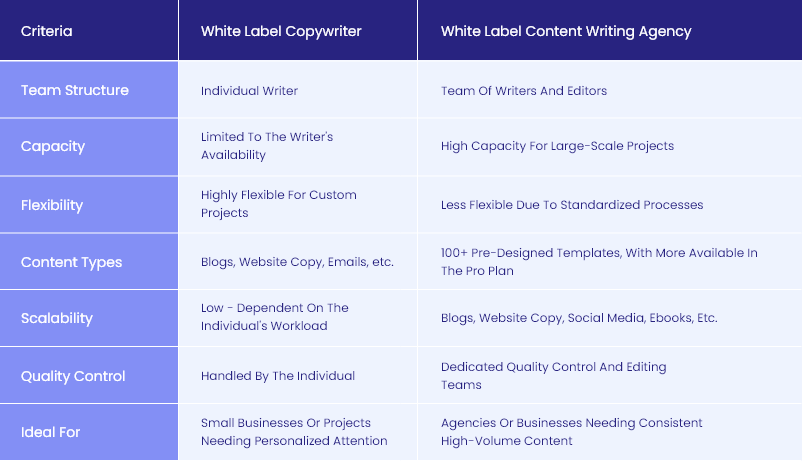
Depending on your business needs, you may choose between hiring an individual white label copywriter or working with a white label content writing agency. Each offers unique advantages, and understanding the differences will help you select the right option for your content strategy.
White Label Copywriter
A white label copywriter is an individual freelance writer who specializes in producing content that can be rebranded and sold by another company.
They typically work on a per-project or retainer basis, crafting content such as blog posts, website copy, email newsletters, and more.
The main advantage of hiring a white label copywriter is the personalized attention to detail and flexibility in handling specific content needs. However, capacity may be limited depending on the writer’s availability and bandwidth.
Key Differences:
- Works directly with clients on specific tasks.
- Provides more flexibility for unique projects.
- Limited capacity, usually handling smaller volumes of work.
White Label Content Writing Agency
A white label content writing agency offers a team of writers, editors, and strategists to produce larger volumes of content for businesses.
These agencies provide a wide range of copywriting services, including blog writing, social media posts, website copy, and long-form content like whitepapers and eBooks.
The main advantage of working with an agency is the ability to scale content production quickly, manage multiple projects at once, and maintain consistency across different clients.
Key Differences:
- Ability to handle high-volume content production.
- Offers a team-based approach with editors and quality control.
- Ideal for agencies needing to scale quickly and deliver consistent results across multiple clients.
Comparing Content Mills vs. High-Quality Providers
When comparing content mills to high-quality white label content creation services, the differences are stark. Content mills typically focus on quantity over quality, producing low-cost, high-volume content that may lack depth, originality, and proper SEO optimization. In contrast, high-quality providers prioritize crafting well-researched, engaging content tailored to your specific needs. They employ experienced white label copywriters who understand your industry and can produce content that aligns with your brand’s voice and objectives.

Benefits of Using White Label Content Creation Services
Time and Resource Efficiency
- White label content creation allows businesses to save significant time and resources.
- By outsourcing content production, companies can focus on core tasks without managing an in-house team.
- This enables rapid scaling of content output, meeting client demands more effectively.
- Internal teams are freed up to focus on strategy and client management.
Ensuring High-Quality Content
- White label content often matches or surpasses the quality of in-house content.
- Professional white label copywriters are specialists in their field, bringing expertise that results in polished content.
- In-house teams may lack specific expertise, while outsourcing ensures the right skills are applied to every project.
- Quality control processes with white label copywriting services help maintain high standards, keeping content effective and engaging.

Enhancing SEO Strategy
- White label content creation can significantly boost SEO performance.
- Skilled white label copywriters understand SEO best practices, including keyword optimization, meta descriptions, and content structuring.
- Providing clear keyword guidelines to your copywriting services provider ensures search engine-friendly content.
- Regular collaboration with your white label provider helps keep SEO strategies up to date, improving search visibility over time.
Limitations of White Label Content Creation
- Lack of Direct Control: You may have less influence over the content creation process, which can lead to misalignment with your brand’s voice or goals.
- Communication Delays: Working with external providers may result in slower communication and revisions, especially if you’re managing multiple clients.
- Inconsistent Quality: The quality of copywriting services can vary depending on the white label copywriter or agency, which may affect the consistency of your content across different projects.
How to Choose the Right White Label Content Service Provider
Selecting the right provider for white label content creation is crucial to ensuring the quality and consistency of your content. Here’s a checklist to guide you through the evaluation process:
- Experience and Expertise: Review the provider’s portfolio to ensure they have experience in your industry and can deliver the type of content you need.
- Quality of Work: Assess sample content to gauge the quality of writing, adherence to SEO best practices, and alignment with your brand’s voice.
- Client Testimonials and Reviews: Look for feedback from previous clients to understand the provider’s reliability and the quality of their copywriting services.
- Customization Options: Ensure the provider can tailor content to meet your specific needs and isn’t offering generic, one-size-fits-all solutions.
- Turnaround Time: Confirm that the provider can meet your deadlines without compromising quality.
- Pricing Structure: Compare pricing models to ensure they align with your budget without sacrificing quality.
Transparency and clear communication are vital in the white label content creation process. A reliable provider will be upfront about their processes, pricing, and timelines.
Regular updates and open channels of communication help ensure that the content meets your expectations and any issues are addressed promptly. This level of transparency also builds trust, making it easier to collaborate effectively.
Legal Considerations:
- Content Ownership: Verify that the white label partner grants full ownership rights of the content once delivered. This ensures that you can rebrand and distribute it without legal issues.
- Confidentiality: Ensure the provider has confidentiality agreements in place, such as NDAs, to protect your business’s information and prevent them from disclosing that they are producing the content.
Here is the free NDA template for the confidentiality agreement.
- Contract Terms: Review the contract carefully to clarify intellectual property rights, revision policies, and any other legal terms, so you are protected from potential disputes.
Resource: You can download a free white label content creation inquiry template.
https://docs.google.com/document/d/1S2K1dGW1Vz6e-qYUJjL-jfn1iir4nNZgJ6vwb99Riz0/edit?usp=sharing
Conclusion
In this guide, we’ve explored the key aspects of white label content creation: including its definition, the role of a white label copywriter, and the many benefits of using copywriting services for your business. We’ve also provided practical advice on how to choose the right white label content creation service provider, emphasizing the importance of quality, transparency, and communication.