- Understanding Marketing Automation
- 3 Benefits of Marketing Automation for Agencies
- Top Marketing Automation Tools for Agencies
- Implementing Marketing Automation in Your Agency
- Common Challenges and How to Overcome Them
- Identifying Which Tasks to Automate vs. Which to Outsource Strategically
- Conclusion
Marketing automation has transformed how agencies operate. Studies show that agencies using marketing automation see a 451% increase in qualified leads and reduce manual tasks by up to 12 hours per week per team member.
Agencies that haven’t embraced marketing automation risk falling behind competitors who deliver faster results, better client experiences, and higher profit margins. If you are a marketing agency handling a dozen clients, understanding and implementing the right marketing automation strategies can mean the difference between scaling successfully and struggling to keep up with demand.
Understanding Marketing Automation
Marketing automation for agencies centers on workflow creation rather than simple scheduling. Think of it as building a digital assistant that handles routine communications while you focus on creative problem-solving.
How It Works
The platform monitors user behavior across multiple touchpoints – website visits, email opens, form submissions, social media engagement. Based on these actions, it triggers predetermined responses:
Example workflow: A prospect visits your pricing page three times in one week. The system automatically:
- Tags them as “high-interest”
- Sends a case study relevant to their industry
- Notifies your sales team for personal outreach
- Schedules a follow-up email if no response occurs within 48 hours
Core Components That Matter
Marketing automation software for agencies typically includes three essential elements:
Trigger-based email sequences replace manual follow-ups. Instead of remembering to email prospects, the system sends targeted messages based on their actions.
Lead scoring assigns numerical values to prospect behaviors. Downloading a pricing guide might score 20 points, while visiting your team page scores 5 points. When someone reaches 100 points, they’re automatically flagged for sales outreach.
Integration capabilities connect your existing tools. Your project management system can trigger client update emails, or your CRM can automatically segment contacts based on company size.
3 Benefits of Marketing Automation for Agencies
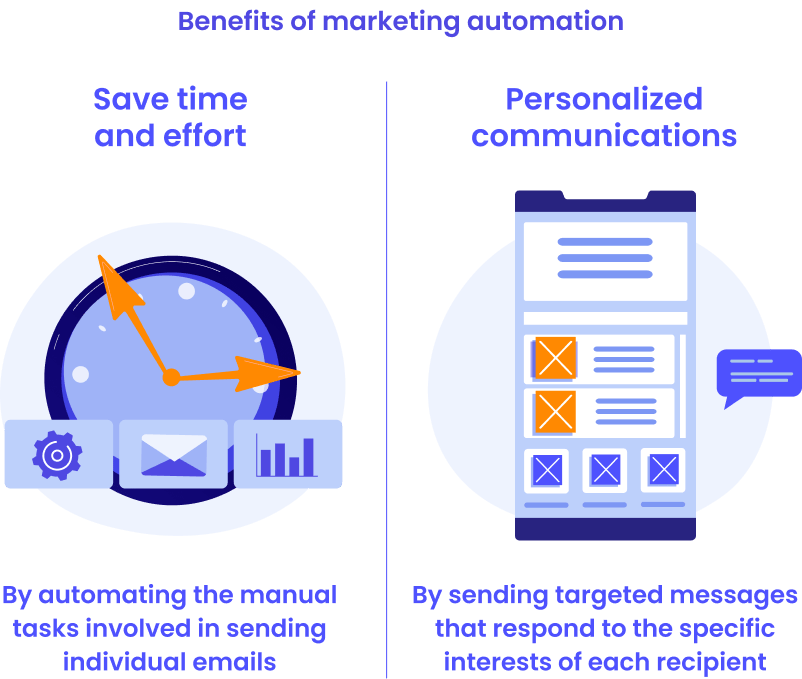
Agencies see immediate improvements in three critical areas: time allocation, client satisfaction, and revenue predictability.
Time Reallocation, Not Just Savings
Rather than “saving time,” automation shifts how you spend it. Account managers stop sending status update emails manually and instead spend that time analyzing campaign performance or developing creative strategies.
Specific time shifts include:
- 15 minutes per day per client on status updates → strategic planning sessions
- 2 hours weekly on lead qualification → high-value prospect meetings
- 30 minutes daily on social media posting → content strategy development
Consistent Client Experience
Manual processes create inconsistencies. One account manager might send weekly updates while another sends them monthly. Automation ensures every client receives the same level of communication regardless of who manages their account.
This consistency particularly benefits agencies during busy periods or staff transitions. Client communication continues seamlessly even when team members are overloaded or new hires are learning processes.
Revenue Predictability Through Lead Nurturing
Automation creates predictable lead flow by nurturing prospects over extended periods. Instead of losing potential clients who aren’t ready to buy immediately, automated sequences keep your agency top-of-mind until they’re ready to engage.
Example
A prospect downloads your agency guide but doesn’t respond to initial outreach. An automated sequence sends:
- Week 1: Industry-specific case study
- Week 3: Client success story video
- Week 6: Free consultation offer
- Week 10: Educational webinar invitation
This approach converts prospects who might otherwise be forgotten, creating a more predictable sales pipeline.
Top Marketing Automation Tools for Agencies

Different agency sizes and specializations require different automation approaches. Here’s an honest breakdown of leading marketing automation software for agencies.
HubSpot
Best for: Agencies wanting all-in-one functionality
Pricing: Free tier available, paid plans start at $45/month
HubSpot combines CRM, email marketing, and sales automation in one platform. The free tier includes basic email sequences and contact management, making it ideal for smaller agencies testing automation.
Strengths: User-friendly interface, extensive educational resources, strong integration ecosystem
Weaknesses: Expensive as contact lists grow, limited customization in lower tiers
ActiveCampaign
Best for: Email-focused agencies needing advanced segmentation
Pricing: Starting at $29/month
ActiveCampaign excels at complex email workflows and behavioral targeting. You can create intricate sequences that respond to multiple triggers simultaneously.
Strengths: Powerful automation builder, excellent deliverability, affordable pricing
Weaknesses: Steeper learning curve, limited social media features
Marketo
Best for: Large agencies with dedicated marketing operations teams
Pricing: Custom pricing, typically $1,000+/month
Marketo handles enterprise-level complexity with advanced lead scoring, account-based marketing features, and sophisticated reporting.
Strengths: Enterprise-grade features, powerful analytics, extensive customization
Weaknesses: Requires technical expertise, expensive implementation
Platform Comparison Table
Below is a quick recap of marketing automation software for agencies.
| Platform | Best For | Starting Price | Learning Curve | Key Strength |
| HubSpot | Small-medium agencies | $45/month | Easy | All-in-one solution |
| ActiveCampaign | Email-focused workflows | $29/month | Medium | Advanced automation |
| Marketo | Enterprise agencies | $1,000+/month | Difficult | Enterprise features |
Choose based on your current team size and technical expertise rather than features you might need eventually.
Implementing Marketing Automation in Your Agency
Successful automation implementation requires strategic planning rather than jumping into tool setup. Start by mapping your current processes before introducing new technology.
Step 1: Audit Your Existing Workflows
Document how you currently handle prospects from initial contact through project completion. Identify repetitive tasks that consume significant time but don’t require creative thinking.
Common automation opportunities:
- Initial prospect follow-up sequences
- Client onboarding communications
- Project status updates
- Invoice and payment reminders
- Post-project feedback collection
Step 2: Start Small with High-Impact Workflows
Begin with one simple automation rather than overhauling everything simultaneously. Choose a workflow that affects multiple team members and occurs frequently.
Recommended first automation: New lead follow-up sequence
- Immediate thank-you email with relevant case study
- Day 3: Educational content related to their inquiry
- Day 7: Calendar link for consultation call
- Day 14: Client testimonial video
- Day 21: Last-chance consultation offer
Step 3: Training Your Team on Automation Thinking
Your team needs to shift from “doing tasks” to “designing workflows.” This requires understanding trigger-based thinking rather than schedule-based planning.
Conduct workshops where team members map out their current processes, then identify decision points where automation could take different actions based on prospect behavior.
Common Challenges and How to Overcome Them
Every agency encounters specific hurdles when implementing marketing automation. Understanding these challenges before they occur prevents costly mistakes and ensures smoother adoption.
Data Integration Nightmares
The biggest challenge agencies face involves connecting existing tools without creating data chaos. Multiple systems often store the same contact information differently – one platform might list “ABC Company” while another shows “ABC Co.”
Solution approach:
- Standardize data formats before connecting platforms
- Create naming conventions for companies, contact titles, and campaign tags
- Use dedicated integration tools like Zapier for complex connections
- Designate one team member as the “data owner” to maintain consistency
Test integrations with small contact groups before syncing entire databases. This prevents mass data corruption that can take weeks to clean up.
Maintaining Personal Touch in Automated Messages
Clients expect personalized communication, but automated emails often sound robotic. The challenge lies in creating messages that feel personal while being systematically generated.
Personalization tactics that work:
- Reference specific client industries or company sizes in email templates
- Include account manager names and direct contact information
- Use dynamic content to insert relevant case studies automatically
- Create separate email tracks for different client types (B2B vs. B2C, small vs. enterprise)
Write automated emails as if you’re speaking directly to one person, not broadcasting to hundreds. Use “you” instead of “clients” and include specific details that matter to each segment.
Identifying Which Tasks to Automate vs. Which to Outsource Strategically
Not every agency task benefits from automation. Some processes require human judgment, while others need specialized expertise that’s costly to maintain in-house. Making the right decision between automation, hiring, and outsourcing affects both operational efficiency and service quality.
Decision framework for task allocation:
Automate when tasks are:
- Repetitive and rule-based (email follow-ups, data entry)
- Time-sensitive but low-complexity (appointment reminders, status updates)
- High-volume with predictable outcomes (lead scoring, basic reporting)
Keep in-house when work requires:
- Strategic thinking and client relationship management
- Creative problem-solving specific to your agency’s approach
- Real-time decision-making during client interactions
Consider outsourcing when tasks:
- Require specialized technical skills used sporadically
- Have fluctuating demand that makes full-time hiring inefficient
- Need expert-level execution but aren’t core to your agency’s competitive advantage
Dedicated team
Scale your agency with a dedicated WordPress developer. With great communication, we make sure to keep your builds on track and on time.
Real-world example: An agency might automate client onboarding emails and project status updates, while outsourcing WordPress development work to specialists and keeping strategic consulting in-house. This approach lets them focus automation on systematic communications while ensuring expert delivery of technical work without maintaining expensive development teams.
The key is recognizing that automation excels at process efficiency, but some deliverables require human expertise that’s better accessed strategically rather than built internally. This balanced approach often produces better client outcomes while maintaining healthier profit margins.
Smart agencies use automation to handle operational workflows while partnering with specialized agencies for staff augmentation, creating scalable service models without overwhelming overhead costs.
Building Predictable Revenue Through Service Models
Beyond automation and staff augmentation, successful agencies increasingly adopt subscription-based service offerings that create recurring revenue while reducing sales cycle pressure.
Subscription service advantages:
- Predictable monthly income reduces cash flow uncertainty
- Automated billing and renewals minimize administrative overhead
- Client retention focus shifts from constant prospecting to service delivery
- Scalable delivery models through partnerships handle capacity fluctuations
Website maintenance, ongoing optimization, and technical support services translate naturally into monthly subscriptions. Agencies can offer these services through specialized partners while maintaining client relationships and predictable revenue streams. In other words, subscription-based services let you generate automated recurring income.
Website as a service
Website As a Service [WAAS] provides complete website solutions including design, hosting, and maintenance through a convenient subscription model for Agencies.
Conclusion
Marketing automation for agencies represents a fundamental shift from reactive task management to proactive workflow design. The agencies thriving today aren’t just using automation tools – they’re strategically combining systematic processes with specialized expertise to deliver exceptional client results while maintaining sustainable operations.
The key lies in understanding automation’s true purpose: creating space for high-value work rather than simply eliminating tasks. When agencies automate routine communications and administrative processes, they free up creative and strategic capacity that directly impacts client satisfaction and business growth.
Success requires balancing three elements: automated efficiency for repetitive tasks, in-house expertise for core competencies, and strategic partnerships for specialized deliverables. This approach lets agencies scale their operations while maintaining service quality and reasonable overhead costs.
At White Label Agency, we help marketing agencies with scalable WordPress staffing services. Focus on what you do best while we handle the specialized development work that keeps your clients satisfied and your projects profitable. Contact us to explore how strategic partnerships can enhance your workflows.