
Growing an agency is like tending a garden. Rush the process, and you’ll end up with weak roots that can’t support long-term growth. The difference between agencies that thrive and those that flame out isn’t just about landing big clients or hiring fast. It’s about building sustainable systems that can scale without breaking.
According to recent industry data, 70% of agencies that experience rapid growth without proper infrastructure fail within three years. The survivors? They’re the ones who understood that sustainable agency growth requires strategic planning, operational excellence, and a clear vision of where they’re headed.
Whether you’re running a digital marketing agency with five employees or managing a creative studio looking to double your revenue, this guide will show you how to grow your agency the right way. We’ll cover everything from strengthening your market position to building scalable operations, winning clients, and avoiding the common pitfalls that derail agency expansion.
Foundations for Agency Growth
Before you can scale effectively, you need rock-solid foundations. Think of this phase as building the bedrock that will support everything else you do. Without clear positioning and well-defined goals, even the best marketing efforts and operational improvements will struggle to create lasting impact.
The agencies that achieve sustainable growth don’t just stumble into success, they deliberately craft their market position and set measurable targets that guide every decision. This foundational work might not feel as exciting as landing your next big client, but it’s what separates agencies that grow predictably from those that plateau after initial success.
Define and Strengthen Your Positioning
The biggest mistake agencies make when trying to grow is attempting to be everything to everyone. It’s counterintuitive, but the narrower your focus, the faster you can scale. Specialization creates expertise, and expertise commands premium pricing and referrals.
Consider the difference between “We do digital marketing” and “We help B2B SaaS companies increase trial-to-paid conversion rates through targeted content marketing and email automation.” The second positioning immediately tells prospects whether you’re the right fit, attracts higher-quality leads, and positions you as an expert rather than a generalist.
Industry specialization is often the most powerful approach for agency scaling strategies. When you focus on specific industries – whether that’s e-commerce, healthcare, or professional services – you develop deep knowledge of industry challenges, regulations, and customer behavior. This expertise becomes a competitive moat that’s difficult for generalist agencies to cross.
Service specialization can be equally effective. Instead of offering web design, SEO, social media, and PPC, consider becoming the go-to agency for conversion rate optimization or marketing automation implementation. HubSpot’s agency partner data shows that specialized agencies grow 40% faster than generalists and maintain 25% higher profit margins.
Your value proposition should answer three questions clearly:
- Who do you serve? (specific audience)
- What problem do you solve? (specific outcome)
- How are you different? (unique approach or expertise)
For example, one of our clients repositioned from “full-service digital agency” to “B2B email marketing agency.” This shift tripled their qualified leads within six months because prospects knew exactly what they offered and whether it matched their needs.
Set SMART Growth Goals
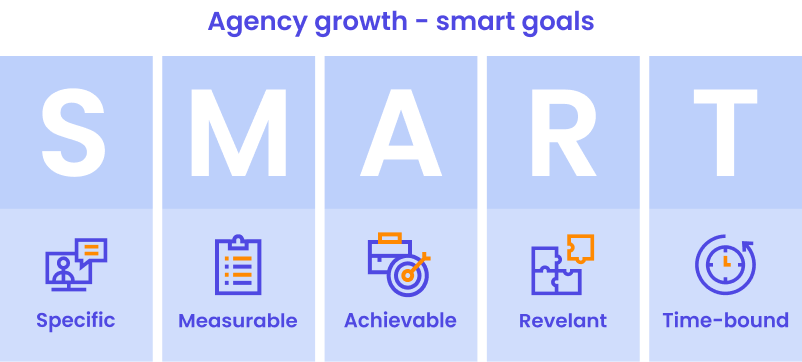
Vague goals produce vague results. “Growing the business” isn’t a strategy, it’s a wish. Smart agency business growth requires specific, measurable targets that create accountability and guide resource allocation.
Short-term goals (3-12 months) should focus on operational improvements and immediate growth drivers:
- Increase monthly recurring revenue by 25%
- Improve client retention rate to 90%
- Launch three new service offerings
- Build email list to 2,000 qualified prospects
Long-term goals (1-3 years) should address strategic positioning and market expansion:
- Achieve $2M annual recurring revenue
- Become the leading WordPress agency in the Midwest
- Expand into two new service verticals
- Build a team of 25 specialists
The key performance indicators (KPIs) you track will determine where you focus your energy. Revenue growth is important, but it’s not the only metric that matters for sustainable expansion:
Financial KPIs:
- Monthly recurring revenue (MRR) growth rate
- Average client lifetime value
- Gross profit margins by service line
- Cash flow runway
Operational KPIs:
- Project delivery time vs. estimates
- Team utilization rates
- Client satisfaction scores
- Employee retention rate
Marketing KPIs:
- Cost per acquisition by channel
- Lead-to-client conversion rate
- Brand awareness in target market
- Referral rate from existing clients
One agency we work with tracks “client success metrics” – the specific outcomes their clients achieve through the partnership. This approach has helped them maintain a 95% client retention rate because they’re genuinely invested in client results, not just deliverables.
Building a Scalable Agency Infrastructure

Infrastructure might not be the most glamorous aspect of growing a digital agency, but it’s what enables everything else. Without scalable systems, every new client becomes harder to manage, every new team member creates more chaos, and every growth opportunity feels overwhelming rather than exciting.
The agencies that scale smoothly are those that invest in infrastructure before they need it. They build systems when they have time to think strategically, not when they’re drowning in client work and can barely keep up with demand. This proactive approach to agency operations and growth creates the foundation for sustainable expansion.
Streamline Internal Operations
Chaos doesn’t scale. If your team is constantly reinventing processes, searching for information, or unclear about responsibilities, adding more people and clients will only amplify the problems. Streamlined operations aren’t just about efficiency, they’re about creating predictable outcomes that clients can trust.
Standardized workflows are the backbone of scalable operations. Every recurring process should have a documented procedure that anyone on your team can follow. This includes:
- Client onboarding sequences with clear milestones and deliverables
- Project discovery and planning templates
- Quality assurance checklists for each service offering
- Client communication protocols and escalation procedures
- Reporting templates and delivery schedules
Project management tools like Asana, Monday, or ClickUp become essential as you scale. But the tool isn’t what matters, it’s having consistent processes that everyone follows. We’ve seen agencies transform their operations simply by implementing a standardized project intake form that captures all necessary information upfront, eliminating the back-and-forth that typically delays project starts.
Time tracking and resource allocation provide crucial data for agency scaling strategies. Without accurate time data, you can’t price projects profitably, allocate resources effectively, or identify which services are most valuable. Tools like Harvest or Toggl integrate with most project management platforms and provide insights that inform better business decisions.
Documentation might feel like busy work, but it’s what allows you to delegate effectively and maintain quality as you grow. Create:
- Service delivery playbooks for each offering
- Client communication templates and scripts
- Training materials for new team members
- Standard operating procedures for common tasks
- Knowledge bases for frequently asked questions
One agency increased their project completion speed by 30% simply by creating detailed project templates. New projects no longer started from scratch – they began with proven frameworks that team members could customize for each client’s needs.
Invest in Technology and Automation
The right technology stack can 10x your team’s productivity, but the wrong tools create more work than they eliminate. Focus on automation that removes repetitive tasks and provides better client experiences, not just technology for technology’s sake.
Customer Relationship Management (CRM) becomes critical as you scale beyond 20-30 active prospects and clients. HubSpot, Pipedrive, or Salesforce help you track interactions, automate follow-ups, and ensure no opportunities fall through the cracks. But more importantly, a good CRM provides data on which marketing channels produce the best clients and which sales activities drive the highest conversion rates.
Client reporting automation saves hours each month and improves client satisfaction. Tools like Google Data Studio, AgencyAnalytics, or our own reporting solutions can automatically compile performance data, generate branded reports, and deliver them to clients on schedule. This consistent communication builds trust and reduces the “what are you working on?” emails that interrupt productive work.
Billing and invoicing automation through platforms like FreshBooks, QuickBooks, or Stripe eliminates late payments and reduces administrative overhead. Automated payment reminders, recurring billing for retainer clients, and integrated time tracking ensure you get paid quickly for the work you deliver.
Communication tools like Slack for internal coordination and platforms like Calendly for client scheduling create smoother interactions. But the key is choosing tools that integrate well together rather than managing a dozen disconnected platforms.
The goal isn’t to automate everything, it’s to automate the routine tasks that don’t require human creativity or relationship-building. This frees your team to focus on strategy, creative problem-solving, and building stronger client relationships.
Build a Flexible Team Structure
Scaling agency team capacity is one of the most challenging aspects of growth. Hire too quickly, and you’ll struggle with cash flow and cultural integration. Hire too slowly, and you’ll lose opportunities or burn out your existing team members.
The hidden costs of in-house hiring often surprise growing agencies. Beyond salary and benefits, consider recruitment costs, onboarding time, management overhead, and the risk of hiring mismatches. A single bad hire can cost 2-3x their annual salary when factoring in lost productivity, team disruption, and replacement expenses.
Additional challenges with traditional hiring include:
- 3-6 month ramp-up time before new hires become productive
- Difficulty finding specialized skills in local talent markets
- Fixed costs that continue during slow periods or economic downturns
- Management complexity as team size grows
- Competition for top talent driving up salary demands
The full-time vs. freelancer decision depends on your growth trajectory and cash flow situation. Full-time employees provide stability, deeper integration with your processes, and stronger client relationships. Freelancers offer flexibility, specialized expertise, and lower fixed costs during uncertain periods.
Strategic staffing partnerships provide a third option that many growing agencies overlook. Instead of choosing between expensive hiring and unreliable freelancers, partner with specialized agencies that provide dedicated team members who integrate with your processes while remaining technically employed elsewhere.
This approach offers several advantages for agency scaling strategies:
- Access to specialists without recruitment overhead
- Flexible capacity that can scale up or down based on demand
- Reduced HR obligations while maintaining team consistency
- Lower fixed costs compared to full-time hiring
- Faster deployment since specialists are already trained
For example, at White Label Agency, we provide dedicated WordPress developers and designers who work exclusively with one client agency at a time. These team members integrate with your Slack channels, attend your meetings, and follow your processes, but we handle all HR obligations, training, and management overhead. This arrangement allows agencies to scale development capacity quickly without the risks and costs of traditional hiring.
Dedicated team
Scale your agency with a dedicated WordPress developer. With great communication, we make sure to keep your builds on track and on time.
A hybrid approach often works best for growing agencies:
- Core leadership and account management roles as full-time positions
- Specialized technical roles through strategic staffing partnerships
Building a talent pipeline before you need it prevents scrambling when opportunities arise. This includes maintaining partnerships with staffing agencies and creating internal development programs. The key is having more than one option available so you can choose the best fit for each situation.
Winning and Retaining Clients

Client acquisition and retention are the lifeblood of sustainable agency growth. But there’s a crucial distinction between agencies that chase every lead and those that systematically build a client acquisition engine. The most successful agencies understand that winning the right clients is more important than winning more clients.
Research from the Agency Management Institute shows that agencies with strong client acquisition systems grow 3x faster than those relying on referrals alone. However, the same data reveals that client retention has 5x more impact on profitability than acquisition. This means your growth strategy must balance both acquiring new clients and keeping existing ones happy and engaged.
Develop a Consistent Marketing Strategy
The cobbler’s children have no shoes, and many agencies have terrible marketing despite helping clients achieve amazing results. This self-neglect limits growth potential and forces reliance on unpredictable referral streams. Developing agency marketing strategies that consistently generate qualified leads is essential for how to scale an agency effectively.
Content marketing remains one of the most effective approaches for agency business growth. By sharing expertise through blog posts, case studies, and industry insights, you demonstrate capability while building trust with prospects. The key is consistency and value: publish helpful content regularly rather than promotional material sporadically.
Focus your content on the problems your ideal clients face:
- Industry-specific challenges and solutions
- Behind-the-scenes case studies showing your process
- Tactical guides that prospects can implement immediately
- Thought leadership on industry trends and changes
Search engine optimization (SEO) ensures your content reaches people actively searching for solutions. Target long-tail keywords that reflect specific client needs rather than broad industry terms. “WordPress development for marketing agencies” attracts more qualified leads than “web development services.”
Strategic partnerships can accelerate client acquisition for agencies without increasing marketing costs. Identify complementary service providers who serve your ideal clients but don’t compete directly. For example, if you specialize in SEO, partner with social media marketing agencies, content creators, or marketing consultants who need reliable SEO partners.
LinkedIn outreach works particularly well for B2B agencies. Share valuable insights, engage with prospects’ content, and build relationships before pitching services. The goal is to become a trusted resource in your industry, not just another vendor sending cold messages.
Paid advertising can accelerate results when you have proven messaging and clear conversion paths. Start with small budgets on platforms where your ideal clients spend time. Google Ads work well for high-intent searches, while LinkedIn ads excel for reaching specific job titles and industries.
Track marketing performance by channel to optimize your investment:
- Cost per lead by source
- Lead-to-client conversion rates
- Customer acquisition cost vs. lifetime value
- Time from first touch to closed deal
Prioritize Relationship-Based Growth
Acquisition gets the attention, but retention drives profitability. It costs 5-10x more to acquire a new client than to retain an existing one, and retained clients typically spend 67% more than new ones over time. Building a referral engine and maximizing client relationships should be core components of your growth strategy.
Client retention strategies start with delivering exceptional results consistently:
- Set clear expectations and exceed them regularly
- Communicate proactively about project status and challenges
- Provide strategic insights beyond basic service delivery
- Respond quickly to questions and concerns
- Celebrate client wins and share in their success
Upselling and cross-selling become natural when you’re genuinely invested in client success. Instead of pushing additional services, identify opportunities where expanded work would drive better results for the client. This consultative approach builds trust while increasing account value.
Examples of natural expansion opportunities:
- Website maintenance after development projects
- SEO services after website launches
- Content marketing to support paid advertising campaigns
- Analytics setup and reporting for ongoing optimization
WordPress maintenance plans
WordPress Maintenance Plans ensure site security, performance, and uptime. Choose custom plans with backups, monitoring, and unlimited content edits.
Referral programs can systematize word-of-mouth marketing. Offer incentives for successful referrals, but focus more on making referrals easy than making them lucrative. Provide clients with simple tools to introduce you to colleagues – email templates, one-page service summaries, or case studies they can share.
Client success programs proactively ensure clients achieve their goals. Regular check-ins, performance reviews, and strategic planning sessions demonstrate ongoing value beyond project delivery. Clients who see measurable results from your work become natural advocates for your services.
One agency increased their average client lifetime value by 180% simply by implementing quarterly business reviews. These sessions focused on analyzing results, planning future initiatives, and identifying new opportunities for collaboration.
Mastering Financial Management for Growth

Money management can make or break your scaling efforts. Agencies often struggle with cash flow because they focus on revenue growth without understanding the financial dynamics that enable sustainable expansion. Smart financial management provides the runway for strategic investments and the confidence to pursue bigger opportunities.
Understanding your numbers isn’t just about tracking revenue, it’s about identifying which clients, services, and activities generate the most profit. This insight informs every major decision about pricing, hiring, service development, and client acquisition strategies.
Set and Monitor Financial KPIs
Gross margin analysis reveals which services generate the most profit after direct costs. Calculate gross margin by subtracting direct labor, contractor payments, and other variable costs from revenue. Services with margins below 50% typically indicate pricing problems or inefficient delivery processes.
Track margins by:
- Service line (web development vs. SEO vs. content marketing)
- Client size (enterprise vs. small business)
- Project type (custom work vs. standardized packages)
- Team member (identifying top performers and training needs)
Client profitability goes beyond gross margin to include account management time, communication overhead, and opportunity costs. Some clients require significantly more attention than others, affecting overall profitability despite similar project values.
Red flags for unprofitable client relationships:
- Constant scope creep and revision requests
- Excessive meetings and communication requirements
- Late payments or payment disputes
- Unrealistic expectations or timeline demands
Client lifetime value (CLTV) measures the total profit generated from a client relationship. Calculate CLTV by multiplying average monthly client value by average relationship length, then subtracting acquisition and service costs. This metric helps justify marketing investments and identifies which client types to pursue.
Cash flow management becomes critical as you scale. Growing agencies often experience cash crunches despite profitable operations because of timing differences between expenses and payments. Monitor:
- Accounts receivable aging (how quickly clients pay)
- Monthly cash burn rate (fixed expenses)
- Cash runway (months of expenses covered by current cash)
- Seasonal fluctuations in revenue and expenses
Recommendation
Download our free guide breaking down 5 ways to reduce your agency costs.
Pricing Strategies for a Growing Agency
Value-based pricing generates higher margins than hourly billing and aligns your incentives with client success. Instead of selling time, sell outcomes and transformations. This approach requires understanding the financial impact of your work on client businesses.
Examples of value-based pricing:
- Website redesign priced based on expected conversion rate improvements
- SEO services tied to organic traffic growth targets
- Marketing automation priced on lead generation capacity
Hourly rates still have a place for undefined scope work or ongoing support, but they should reflect your expertise level and market position. Review rates quarterly and increase them for new clients before raising prices for existing relationships.
Retainer agreements provide predictable revenue and deeper client relationships. Structure retainers around ongoing value delivery rather than just time commitments. Include strategic consulting, performance monitoring, and optimization work that justifies the monthly investment.
Project pricing works well for defined scope work but requires accurate estimation skills. Build in contingency time and clear change order processes to protect profitability when scope expands.
When to raise prices:
- When demand exceeds capacity
- After developing specialized expertise
- When delivering measurably better results
- During contract renewals (easier than mid-engagement)
Price increases should be communicated as investments in better service delivery, not arbitrary cost increases. Position them around capability improvements, market developments, or enhanced service offerings.
Cash Flow Management Tips
Invoice terms and collection directly impact cash flow. Net 15 terms generate cash faster than Net 30, and automated payment systems reduce collection delays. Consider offering small discounts for immediate payment or charging interest on late payments.
Project deposits and milestone payments improve cash flow for larger projects. Collect 25-50% upfront, with additional payments tied to project milestones rather than completion. This approach reduces risk and provides working capital throughout the project.
Emergency fund provides security during economic downturns or unexpected client losses. Maintain 3-6 months of operating expenses in readily accessible accounts. This runway allows strategic decision-making rather than panic responses to temporary challenges.
Growth investments should be planned and budgeted rather than reactive. Whether hiring new team members, upgrading technology, or expanding marketing efforts, model the financial impact before committing resources. Consider the payback period and impact on cash flow timing.
3 Common Pitfalls That Block Agency Growth (And How to Avoid Them)

Even agencies with solid strategies can stall or fail due to predictable mistakes. Understanding these common pitfalls helps you recognize warning signs early and make course corrections before small problems become major obstacles to sustainable agency growth.
These pitfalls aren’t random. They follow patterns that occur at specific growth stages. Recognizing where you are in the growth cycle and which challenges to expect helps you prepare proactively rather than react defensively to problems.
Overpromising and Under-Delivering
The pressure to win new business can lead to commitments that are difficult or impossible to fulfill. Overpromising creates a cycle of disappointed clients, strained team members, and damaged reputation that ultimately limits how to grow your agency effectively.
The hidden costs of bad-fit clients extend beyond immediate project challenges. Difficult clients consume disproportionate time and energy, reduce team morale, and create opportunity costs by preventing work on better-fit accounts. They also generate negative word-of-mouth that can damage your market reputation.
Signs of bad-fit clients include:
- Unrealistic budget expectations for desired outcomes
- Resistance to your proven processes and recommendations
- History of frequent agency changes or partnership failures
- Misaligned values around quality, timeline, or communication
Setting realistic expectations starts during the sales process. Be transparent about what’s achievable within budget and timeline constraints. Provide examples of similar projects and their outcomes. Document assumptions and dependencies that could affect results.
Scope management prevents projects from expanding beyond profitable boundaries. Include clear deliverables, revision limits, and change order processes in every contract. Train your team to identify scope creep early and communicate additional costs before doing extra work.
Quality assurance processes ensure consistent delivery standards. Create checklists for each service offering, implement peer review processes, and maintain client feedback loops that catch issues before they become major problems.
Growing Without Processes in Place
Premature scaling (adding clients or team members faster than systems can support) is one of the most common reasons agencies plateau or fail. Without proper processes, each new addition creates exponential complexity rather than linear growth.
Why premature scaling backfires:
- Quality becomes inconsistent across projects and team members
- Communication breaks down as informal processes reach capacity limits
- Client satisfaction decreases due to coordination failures
- Team members become overwhelmed and less productive
- Profit margins decline as inefficiencies compound
Process development timeline should precede growth initiatives:
- Document current workflows and identify improvement opportunities
- Implement standardized procedures for high-frequency activities
- Train team members on new processes and gather feedback
- Refine processes based on real-world usage and results
- Scale team and client base using proven systems
Warning signs of insufficient processes:
- Projects consistently exceed estimated timelines or budgets
- Team members frequently ask for clarification on routine tasks
- Client onboarding takes longer than expected or varies significantly
- Quality issues increase as workload grows
- Internal communication becomes chaotic or unclear
Building processes that scale requires thinking beyond current needs. Design workflows that can handle 2-3x your current volume without major modifications. Include decision trees for common scenarios and escalation procedures for unusual situations.
Neglecting Your Own Brand Marketing
Agencies often become so focused on client work that they neglect their own marketing efforts. This creates dangerous dependence on referrals and limits growth potential during market changes or competitive pressures.
The referral trap feels comfortable but creates vulnerability. While referrals are valuable, relying exclusively on them means you have little control over lead generation timing or volume. Economic downturns, client losses, or competitive changes can quickly dry up referral sources.
Consistent marketing investment should be treated like any other business essential, not something you do when you have extra time or budget. Allocate specific resources to your own brand building and lead generation efforts.
Content marketing for agencies demonstrates expertise while attracting qualified prospects. Share case studies, industry insights, and strategic frameworks that showcase your thinking and results. The goal is to become a recognized expert in your niche, not just another service provider.
Networking and industry presence builds relationships that generate future opportunities. Attend industry conferences, participate in professional associations, and engage with potential clients and partners on social media platforms.
Marketing accountability requires the same measurement and optimization you provide to clients. Track lead sources, conversion rates, and customer acquisition costs. Test different messaging, channels, and approaches to optimize your marketing investment.
Conclusion
Sustainable agency growth isn’t about working more hours or chasing every opportunity, it’s about building systems that create predictable, profitable expansion. The agencies that thrive long-term are those that invest in strong foundations before they’re forced to do so by crisis or opportunity.
The key principles for how to grow your agency successfully include:
Strategic positioning that clearly defines who you serve and how you’re different from competitors. Specialization creates expertise, and expertise commands premium pricing and strong referrals.
Scalable infrastructure with documented processes, appropriate technology, and flexible team structures. These systems enable growth without sacrificing quality or overwhelming your team.
Balanced client strategies that acquire the right prospects while maximizing value from existing relationships. Retention and referrals drive more profitable growth than constant acquisition.
Financial discipline that tracks the metrics that matter and prices services for sustainable profitability. Understanding your numbers enables confident decision-making and strategic investments.
Proactive problem-solving that anticipates common growth challenges and addresses them before they become limiting factors.
The difference between agencies that scale successfully and those that plateau isn’t talent, luck, or market conditions, it’s the discipline to build sustainable systems that support long-term growth.
At White Label Agency, we’ve helped hundreds of agencies implement these principles through our WordPress staffing services. When you partner with our team, you gain the capacity to take on more projects without the complexity of hiring and managing additional developers. Our dedicated team members integrate seamlessly with your processes, allowing you to focus on strategy, client relationships, and business development while we handle the technical execution.
Let’s discuss how our WordPress expertise can support your expansion goals and help you build the agency you’ve always envisioned.