- “I do not have an in-house developer: why not hire internally?”
- “I have an in-house developer: why outsource WordPress?”
- “I do not want to focus internally on development because my main service is different”
- “I landed a project with a tight deadline, but my developers are busy”
- Team up with WLA if you are facing one of those scenarios
Many marketing agencies think outsourcing WordPress development means losing control or reducing quality. In practice, it can work the other way. Outsourcing might improve your margins, speed up delivery, and make scaling easier because you still own the final product. The real question is finding a reliable partner and figuring out when it makes financial sense for your situation.
This article walks through practical scenarios agencies face at different stages: whether you have no internal developers, one busy developer, or a team focused on services other than WordPress. Each scenario includes actual numbers so you can see where WordPress outsourcing fits your situation.
“I do not have an in-house developer: why not hire internally?”
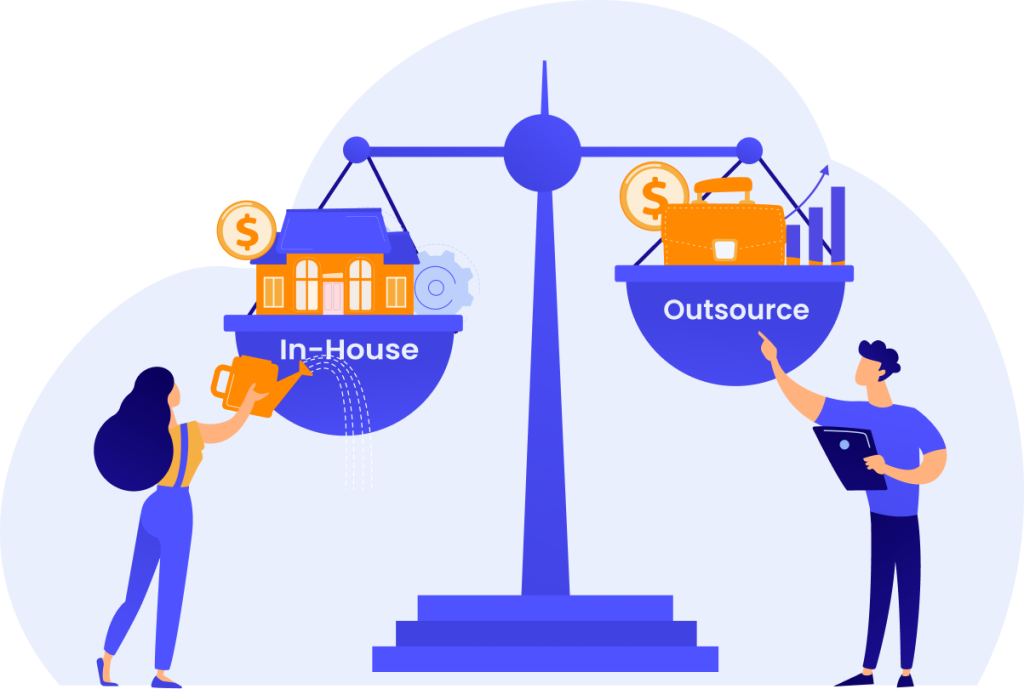
The math on hiring a WordPress developer internally seems simple at first. A mid-level WordPress developer in the US typically costs around $70,000-$90,000 per year in salary, which breaks down to roughly $6,000-$7,500 per month. But there are other costs beyond salary.
Below, we list some of the expenses that can come with hiring a developer internally. Here is what they like:
| Cost category | Monthly cost (USD) |
| Base salary (mid-level developer) | $6,000-$7,500 |
| Employer taxes (FICA, unemployment) | $450-$575 |
| Health insurance | $400-$600 |
| Paid time off (10-15 days/year) | $250-$375 |
| Retirement benefits (3-5% match) | $180-$375 |
| Equipment, software, training | $150-$300 |
| Total monthly cost | $7,430-$9,725 |
An outsourced WordPress developer with similar experience typically costs $4,000-$5,500 per month through an agency like ours. The savings are immediate, but the real difference shows up in how quickly they start delivering value.
When you hire internally, there’s a risk you may not always think about upfront. You might find someone who’s technically solid but hasn’t worked in an agency before. They might not know the project management tools you use, or they might need time to get used to collaborating remotely and following development standards set by someone else. The onboarding can take longer than expected while they adjust to how your agency works.
Outsourcing can help with this, though it’s not automatic. If you work with developers who have agency experience, they’re more likely to already know the setup. They’ve probably used similar tools and understand the pace at which agencies move.
There’s also what happens if it doesn’t work out. If you hire someone internally and realize after a few months that it’s not a good fit, you’re back to posting the job, doing interviews, and onboarding someone new. With outsourcing, you can usually make a change without restarting everything, although that depends on who you’re working with. At WLA, for example, our agency partners can always request swapping a developer, though it happens rarely, as we always try to match them with the right fit.
Dedicated team
Scale your agency with a dedicated WordPress developer. With great communication, we make sure to keep your builds on track and on time.
And there’s the administrative side of hiring internally, too. This includes career planning conversations, salary reviews, benefits management, PTO tracking, and performance reviews. It’s part of having employees, but it’s also time that could go toward client work or growing your business.
“I have an in-house developer: why outsource WordPress?”

Having one in-house developer usually works until you land two good projects at the same time. Scaling with internal hires can take months and commits you to costs even when things slow down. On the other hand, outsourcing might help you scale up for busy periods and back down when needed, though, again, it depends on finding the right partner.
Here’s how the numbers could play out in a scenario we see sometimes:
Scenario #1: You land a new client while your developer is busy
Say your agency has a full-time WordPress developer who costs $6,000 per month. You assigned them a project that brings in $12,000 per month, so your profit is $6,000. Then you land a new client who needs brochure websites. The project brings in $5,000, but your developer is already fully booked.
| Option | Monthly cost | Monthly revenue | Monthly profit |
| Decline the new project | $6,000 | $12,000 | $6,000 (stays the same) |
| Outsource for the new project | $10,000 ($6,000 + $4,000) | $17,000 ($12,000 + $5,000) | $7,000 |
| Hire a second internal developer | $12,000 ($6,000 + $6,000+) | $17,000 | $4,000 (your profits drop) |
In this example, outsourcing could add about $1,000 to your monthly profit. Hiring internally might drop your profit to $5,000 and locks you into that cost whether or not you keep both developers busy. You might be betting that the new client will bring in more projects down the line and you’ll make the profits back eventually, but that’s a risk. Outsourcing can help avoid that risk while still taking on the new client. An outsourced developer who has agency experience can start delivering fairly quickly as well, while hiring internally means taking on more cost, more administrative work, and a longer commitment.
Scenario #2: Maintenance requests eating into development time
If you have an experienced developer, they’re probably most valuable on complex projects. When maintenance tasks start piling up, you’re choosing between having your senior developer handle simpler work or turning away revenue.
Let’s put this into a real-life scenario. Say you have a mid-level WordPress developer who costs around $7,000 per month. You assigned them a project that brings in $14,000 per month, so they generate $7,000 in profit. They’ve been with you for a few years and have built many websites.
Recently, you’ve been getting more requests from former and existing clients for website maintenance. Some need plugin updates, some need content changes, and others minor fixes. Your developer is busy with complex projects and struggling to keep up with these smaller tasks. You can’t really package maintenance as a service to sell because you don’t have the capacity to deliver it consistently.
But there’s an opportunity here. If you could handle these requests, you could charge decent money for relatively simple work and keep clients happy. In this case, an outsourced junior developer, who integrates with your system after a few onboarding meetings, might be your answer. The profit margins are lower on maintenance work, but it could bring in additional revenue and let your more experienced developer stay focused on complex projects where they generate more value.
| Approach | Developer cost | Project revenue | Maintenance revenue | Total profit |
| Use mid-level dev for everything | $7,000 | $14,000 (delays likely) | $0 (you turn it down as a service to sell) | $7,000 |
| Outsource a junior dev for maintenance | $10,000 ($7,000 + $3,000) | $14,000 | $4,500 | $8,500 |
The math works out to an extra $1,500 in monthly profit if you outsource the maintenance work. Your developer stays on the complex project, clients get their maintenance done, and you’re offering a service you couldn’t before.
“I do not want to focus internally on development because my main service is different”

Some agencies specialize in branding, marketing strategy, or campaign work. WordPress development isn’t their core service, and they don’t want it to be. But clients still ask for websites, and saying no means leaving projects on the table.
Here’s a scenario we also hear about fairly often:
Scenario: a branding agency asked to build the website
Say you run a branding and marketing agency. Your team includes designers, strategists, and project managers, but you don’t have WordPress developers on staff.
You just finished a brand refresh for a client. They’re happy with the work. Then they ask: “Can you also build the new website?” You want to keep the project because the website ties directly into the brand work you delivered. But you’re stuck:
- You don’t have WordPress development expertise in-house.
- Hiring a developer for one project doesn’t make sense financially.
- Freelancers can be hit or miss and often need extra management.
An outsourced WordPress developer might be an optimal solution here, too. You get access to someone with expertise without spending time on hiring, onboarding, or managing benefits and payroll. The client gets a website that matches their brand, you deliver a complete project, and your margins can increase, too. If you go with a partner like WLA, the development work will happen in a white-label arrangement, meaning that the client will never know that you actually outsourced the work.
“I landed a project with a tight deadline, but my developers are busy”

Tight deadlines happen frequently in agency work. For example, a client may need a website in 6-8 weeks because it’s launching alongside a campaign or product, and the timeline isn’t flexible. You want to take the project, but when you look at your team’s schedule, the capacity just isn’t there.
This comes up in a few different ways:
- Maybe your agency focuses mainly on design or strategy, and WordPress development isn’t your primary service.
- Or your senior developer is already committed to another client project.
- Or you have a junior developer who could probably handle it, but they would need more time than you have, especially if the build is complex.
So you end up in an uncomfortable position. Turning down the work means losing the revenue, and it can also hurt the relationship with a client who might bring more projects later. But trying to force it through with your current team creates its own problems. Something else on the schedule probably gets delayed, the quality might suffer, or your team burns out trying to deliver everything at once.
Web development outsourcing can be the right solution in this case, too. A partner like WLA can step in either on a project basis or by providing a dedicated developer, depending on what works better for your situation. Our developers have worked with agencies before, so they’re already familiar with the tools most teams use and how agency workflows tend to operate. The onboarding is usually minimal because they’ve been through this setup many times.
Once the project wraps up, we step back. You’re not locked into ongoing costs or long-term commitments. And if another tight deadline comes up down the line, you can bring us back in without starting from scratch. The relationship is already there, so the second time is even faster.
Team up with WLA if you are facing one of those scenarios
We’ve worked with 600+ agencies over the past 13 years, building 10,000+ websites. From what we’ve seen, agencies usually aren’t looking for the cheapest option. They’re looking for developers who understand how agencies work, can follow their standards, and deliver on schedule. We believe that’s exactly what we can offer with our team.
Our developers are familiar with project management tools and remote collaboration. And we make sure to assign you someone whose skills fit what you need. You also get a dedicated account manager who is always in contact with you to handle the administrative side and assist with workflow.
The scenarios in this article are situations we see agencies face fairly regularly. If you’re struggling with capacity or unpredictable project pipelines, we are ready to help. Please feel free to reach out if you want to talk through your situation.