- What is White Labeling?
- Private Label Meaning
- 5 Key Differences Between White Label and Private Label
- Market Considerations
- Case Studies: Success Stories in White Label and Private Label
- Decision-Making Framework for Businesses
- Implementation Strategies
- Future Trends in White Label and Private Label Markets
- Conclusion
When businesses look for ways to expand their offerings without developing products or services from scratch, they often consider white label vs private label solutions. These models allow companies to sell products or services under their own brand, even if they don’t create them in-house.
At first glance, the two terms might seem interchangeable, leading to confusion. Both approaches involve third-party production, but their key differences impact how businesses use them.
For digital agencies, understanding the difference between white label and private label is crucial because it affects scalability, branding, and service delivery. If you’re an agency considering outsourcing services like web development or SEO, knowing what is white label versus private labeling can help you choose the right approach.
Before diving into the details, let’s first clarify what is white labeling and how it works in various industries.
What is White Labeling?
When discussing what is white labeling, think of it as a plug-and-play solution for businesses. A white label product or service is produced by one company but rebranded and sold by another as their own.
In digital services, this often applies to:
- Web development – Agencies partner with a white label provider to build WordPress websites under their own brand.
- SEO and digital marketing – Businesses resell SEO or PPC services delivered by an external provider.
- Software solutions – SaaS companies offer white-label software that other businesses can rebrand as their own.
Real-World Example
Imagine a coffee shop that wants to sell its own branded coffee but doesn’t have the resources to roast beans. Instead, it buys pre-roasted beans from a supplier, adds its own packaging, and sells them as its exclusive brand. The original supplier remains anonymous to the customer.
This is how white labeling works in digital services. If a marketing agency lacks in-house WordPress developers, they can outsource projects to a white label agency while presenting the work as their own.
Why White Labeling Works for Digital Agencies
White labeling is especially useful for agencies that:
- Want to scale quickly without hiring in-house developers.
- Need to expand their service offerings without upfront investment.
- Prefer focusing on sales and client relationships rather than technical execution.
Now that we’ve defined what is white label, let’s explore private label meaning and how it differs.
WordPress Outsourcing Services
Enhance your agency’s capabilities with our WordPress outsourcing services. Get expert development, design, and maintenance support tailored to your needs.
Private Label Meaning
While white label solutions offer speed and affordability, some businesses require greater control over product design and branding. To understand private label meaning, think of customization.
Unlike white label services, private label products or services are exclusively made for a single company, often with unique specifications. In other words, unlike white labeling, private label products are not available to multiple resellers. Instead, they are uniquely tailored to meet a specific brand’s requirements.
Real-World Example
Consider a cosmetics brand that wants to launch a unique line of skincare products. Instead of developing formulas in-house, they work with a manufacturer to create a custom product that no other company can sell under the same name. This is private labeling—it offers exclusivity and differentiation.
While private labeling works well for physical products, white labeling is often the better choice for digital services. In the next chapter, we’ll explore the pros and cons of each model to help businesses decide which one fits their needs best.
5 Key Differences Between White Label and Private Label
Now that we’ve explored the fundamentals of white label vs private label, it’s time to better examine how they truly differ. While both models involve outsourcing production, their impact on branding, customization, pricing, and control over the product can vary significantly. Understanding these distinctions is essential for businesses to align their strategy with their long-term goals.
1. Ownership and Control Over Product Specifications
One of the most significant differences between white label vs private label is the level of ownership and control a company has over the product.
- White Label: Businesses purchasing white label products have minimal control over their specifications. The product is pre-made, and companies can only rebrand it without modifying its core functionality or design.
- Private Label: With private labeling, businesses work closely with manufacturers to customize everything from the product’s ingredients to its features and packaging. This ensures exclusivity and a competitive advantage.
2. Customization and Branding Capabilities
Branding plays a crucial role in a company’s success, and the ability to customize a product’s appearance and functionality can determine how well it resonates with customers.
- White Label: Branding is limited to packaging and logo placement. The same product may be sold under different brand names, making differentiation difficult.
- Private Label: Private label products are designed with the company’s brand identity in mind. The business can dictate product formulation, design, and even exclusive features, ensuring a unique market presence.
Recommendation
Check out our comprehensive guide on white label ecommerce.
3. Pricing Strategies and Profit Margins
When comparing private labeling vs white labeling, pricing flexibility is another key factor to consider.
- White Label: Since multiple businesses sell the same product, pricing is often competitive, leading to lower profit margins. The main advantage is reduced costs, but companies must work harder to create value through marketing.
- Private Label: Private label products allow businesses to set their own pricing strategy. Since the product is exclusive, there is less direct competition, enabling companies to charge premium prices and enjoy higher profit margins.
4. Time to Market and Scalability
For businesses looking to expand quickly, the speed of product launch and ease of scaling operations are crucial considerations.
- White Label: Since white label products are pre-made, businesses can start selling almost immediately. This model is ideal for companies that prioritize speed and low upfront investment.
- Private Label: Private labeling requires a longer development process, including product design, testing, and branding. However, once established, it offers greater control and brand loyalty.
5. Quality Control and Assurance
Product quality is a critical factor that influences customer trust and retention.
- White Label: Quality control is primarily managed by the manufacturer. Businesses must rely on the supplier’s standards and have little control over improvements.
- Private Label: Since companies have direct input into production, they can set higher quality standards, perform rigorous testing, and ensure compliance with their brand values.
By evaluating these factors, businesses can determine which model best fits their market strategy and long-term objectives.
Market Considerations

Choosing between white label vs private label goes beyond internal factors like costs and customization—it also depends on consumer behavior, market competition, and industry trends. Let’s explore how each model fits within different market environments.
Consumer Perceptions and Preferences
Customer perception plays a key role in the success of both white label and private label products.
White Label Products
- Seen as cost-effective alternatives to premium brands.
- Consumers may recognize identical products under different brand names, reducing brand loyalty.
- Works well in industries where functionality matters more than branding (e.g., SaaS, digital services, generic household products).
Recommendation
Discover what is white label copywriting and how you can leverage it for your business.
Private Label Products
- Consumers associate them with quality, exclusivity, and brand trust.
- Higher emotional connection leads to greater brand loyalty.
- Particularly effective in beauty, fashion, wellness, and specialty food markets, where differentiation is a competitive advantage.
Competitive Landscape: Which Model Performs Better?
| Market Type | Best Fit |
| Highly Competitive Markets (e.g., e-commerce, consumer electronics) | White Label – Faster entry and cost-efficiency allow businesses to compete without large investments. |
| Premium & Luxury Markets (e.g., high-end skincare, boutique apparel) | Private Label – Brand exclusivity and customization create a stronger customer base. |
| Development & SaaS Services (e.g., digital marketing, automation tools) | White Label – Companies can resell pre-built services without development costs. |
| Retail Chains & Supermarkets (e.g., grocery private label brands) | Private Label – Major retailers use private labeling to create store-exclusive products with better margins. |
Case Studies: Success Stories in White Label and Private Label
Examining real-world applications of white label vs private label helps illustrate how businesses leverage these models to scale, improve efficiency, and drive profitability. Below are two compelling case studies:
White Label Success: Sawyer Media Group’s Growth with WLA

Sawyer Media Group, a digital marketing agency based in Gainesville, Georgia, faced a common challenge: scaling website development without overextending internal resources. Initially, the agency relied on a single freelancer to handle website projects, but as client demand grew, this setup became unsustainable. Delays, workflow bottlenecks, and a lack of scalability threatened their ability to deliver projects efficiently.
The Challenge
- Sawyer Media Group wanted to expand its website development services without hiring a full in-house team.
- Managing increasing workloads with a single freelancer was inefficient and created delays in project delivery.
- The agency needed a reliable and scalable development solution to maintain quality while growing its client base.
The Solution: Partnering with White Label Agency (WLA)
- By outsourcing development to White Label Agency (WLA), Sawyer Media Group gained access to an expert WordPress development team.
- WLA’s team handled both major website builds and ongoing maintenance, allowing Sawyer Media Group to focus on branding, creative work, and client relationships.
- The partnership eliminated bottlenecks, ensured on-time delivery, and improved client satisfaction.
The Results
- Increased web development capacity from 3 to 10 websites per year without hiring additional staff.
- Improved project turnaround times and service efficiency, leading to higher client retention rates.
- Enabled the agency to upsell clients with website maintenance plans, creating an additional revenue stream.
By adopting a white label model, Sawyer Media Group successfully scaled its web development services without taking on the operational burden of an in-house team.
Projects
Outsource web projects with confidence. We provide fixed-price white-label WordPress development and dedicated management with no upfront payment.
Private Label Success: Kirkland Signature – Costco’s Private Label Brand
While white labeling allows for quick scaling and operational flexibility, private labeling offers the potential for higher profit margins and stronger brand loyalty. One of the most successful private label brands in the world is Kirkland Signature, Costco’s in-house brand that has become a retail powerhouse.
The Challenge
- Costco, a wholesale membership-based retailer, sought to increase customer loyalty and differentiate itself from traditional grocery stores.
- The company wanted to provide high-quality products at lower prices while maintaining profitability.
- Competing with well-established national brands meant Costco needed a unique product line that delivered exceptional value.
The Strategy: Private Labeling with Quality & Exclusivity
- Instead of reselling mass-produced products under different brand names, Costco created Kirkland Signature to develop and control its own exclusive product lines.
- The company worked directly with manufacturers to replicate premium brand-quality products (such as Starbucks coffee and Duracell batteries) but sold them at a lower price under the Kirkland Signature name.
- Because Kirkland products were only available at Costco, the brand reinforced customer loyalty and exclusivity, encouraging repeat purchases.
The Results
- Kirkland Signature generates over $50 billion in annual sales, making it one of the most successful private label brands globally.
- The brand covers a vast product range, from food and beverages to clothing, electronics, and household goods.
- Customers now associate Kirkland with premium quality at lower prices, helping Costco retain members and drive long-term growth.
By investing in private labeling, Costco transformed Kirkland Signature into a highly profitable and consumer-trusted brand, proving that private label products can compete with and even surpass national brands when executed correctly.
Decision-Making Framework for Businesses

After exploring the difference between white label and private label, businesses must determine which model best aligns with their goals, resources, and market positioning. The following framework provides a structured approach to making an informed decision.
1. Define Business Objectives
Before choosing private labeling vs white labeling, businesses should establish clear goals for their product or service expansion.
- If the priority is speed to market and low investment, white labeling is the best fit.
- If the goal is brand exclusivity and differentiation, private labeling is the superior choice.
Consider the following questions:
- Do you need a quick solution to expand your offerings without investing in development? → White Label
- Is your business focused on building long-term brand loyalty with unique products? → Private Label
- Do you have the financial resources to invest in product development? → Private Label
- Are you looking for a scalable, low-risk way to offer additional services or products? → White Label
2. Assess Available Resources and Infrastructure
Both models require different levels of investment, infrastructure, and operational management.
| Resource | White Label | Private Label |
| Upfront Cost | Low – only branding costs | High – requires product development |
| Production & Supply Chain | Handled entirely by the manufacturer/provider | Requires active supply chain management |
| Time Commitment | Minimal – ready-made product | Extensive – involves R&D and customization |
| Marketing Needs | Focus on differentiation through branding and service | Requires building product awareness from scratch |
If a business has limited resources and needs fast implementation, white labeling is the better route. If a company has capital and long-term growth aspirations, private labeling offers higher returns.
3. Evaluate Market Demand and Competition
Not all industries are suited for both models. Conducting a competitive analysis and market research ensures businesses choose the right approach.
- White Label is Ideal When:
- There is high demand for existing solutions, and differentiation is not a major factor.
- The industry is service-based (e.g., digital marketing, SaaS, IT services).
- The focus is on scalability rather than uniqueness.
- Private Label is Ideal When:
- The target audience values brand loyalty and unique offerings.
- Competitors are relying on mass-produced products, creating an opportunity for differentiation.
- A business wants higher pricing flexibility and premium positioning.
4. Risk Assessment and Management
Risk tolerance is another key factor in the white label vs private label decision. White labeling carries lower financial and operational risks, while private labeling requires greater investment but offers stronger control over profit margins.
Risk Comparison
| Risk Factor | White Label | Private Label |
| Financial Risk | Low – minimal upfront investment | High – costs of R&D, manufacturing, and marketing |
| Market Competition | High – multiple brands selling the same product | Lower – brand exclusivity and customer loyalty |
| Quality Control | Relies on the manufacturer’s standards | Full control over product quality and specifications |
| Scalability | Easy – quick expansion with minimal commitment | Requires operational scalability and supply chain management |
Businesses with lower risk tolerance may find white labeling a safer option, while those willing to take on more responsibility for long-term rewards may benefit from private labeling.
5. Align the Decision with Long-Term Business Strategy
The final step is aligning the chosen model with the company’s long-term brand vision and market strategy.
✅If the goal is short-term expansion with minimal investment, white labeling is the way to go.
✅ If the aim is to build a strong, premium brand with proprietary products, private labeling is the best fit.
Businesses should weigh short-term gains against long-term growth potential before making their final decision.
Implementation Strategies
Once a company selects its white label or private label approach, the next step is execution. The process varies significantly between the two models.
Launching a White Label Product or Service
Since white labeling involves reselling an existing product, the focus is on branding, marketing, and distribution.
4 Steps to Implement a White Label Strategy
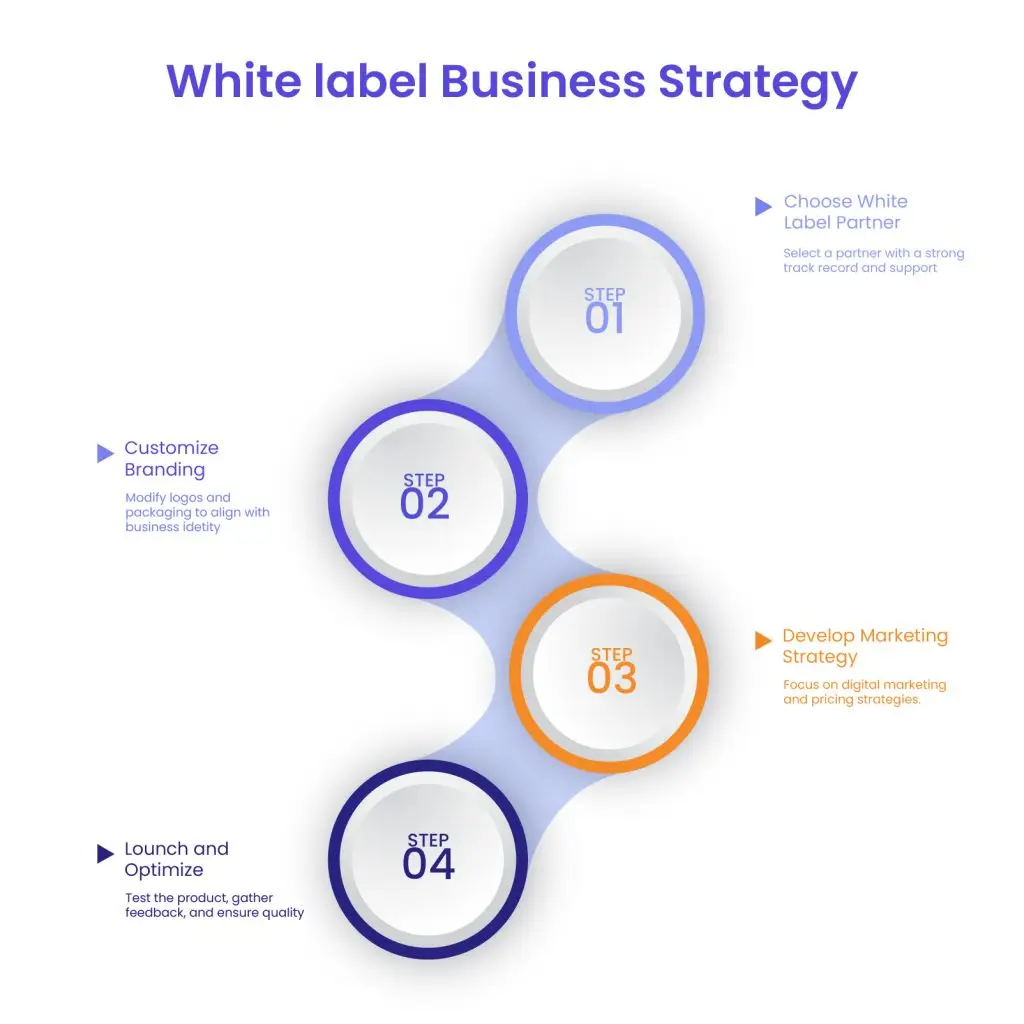
- Choose the Right White Label Partner
- Select a manufacturer or service provider with a strong track record and quality assurance.
- Ensure they offer reliable support, seamless integration, and flexible customization options.
- Customize Branding and Positioning
- If dealing with products, modify logos, packaging, and messaging to align with your business identity.
- Differentiate your offering through customer service, marketing, or bundling additional value.
- Develop a Sales and Marketing Strategy
- Focus on SEO, PPC, and digital marketing to promote your white label service or product.
- Offer tiered pricing and upsell options to increase profitability.
- Launch and Optimize Performance
- Test the product in the market and gather feedback to improve the offering.
- Implement ongoing quality checks and customer support to maintain a competitive edge.
Launching a Private Label Product
Private labeling involves a longer and more complex process but provides greater control and long-term profitability.
5 Steps to Implement a Private Label Strategy
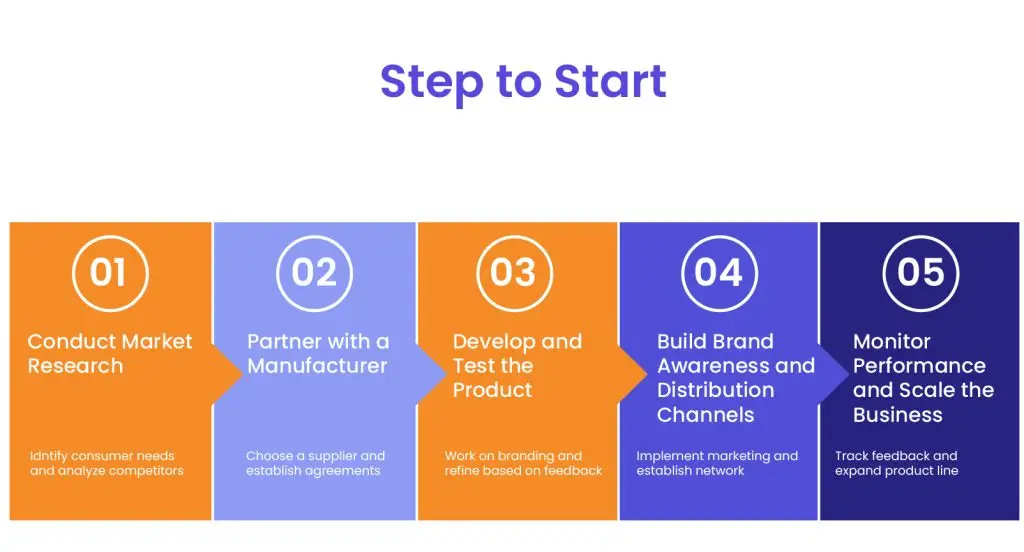
- Conduct Market Research
- Identify consumer needs and niche gaps in the market.
- Analyze competitors to differentiate the product effectively.
- Partner with a Manufacturer
- Choose a supplier that allows full customization and maintains high-quality standards.
- Establish clear agreements on production, delivery timelines, and exclusivity rights.
- Develop and Test the Product
- Work on packaging, branding, and product formulation to align with brand identity.
- Conduct pilot testing and refine the product based on consumer feedback.
- Build Brand Awareness and Distribution Channels
- Implement a strong marketing campaign, leveraging social media, influencer partnerships, and content marketing.
- Establish distribution networks, whether through retail partnerships, e-commerce, or direct-to-consumer models.
- Monitor Performance and Scale the Business
- Track sales, consumer feedback, and adjust the strategy accordingly.
- Expand the product line based on market trends and demand shifts.
Both models require ongoing optimization and strategic refinement to ensure long-term success.
Future Trends in White Label and Private Label Markets
The white label and private label industries are constantly evolving, influenced by technological advancements, shifting consumer behaviors, and emerging market demands.
Emerging Trends in White Labeling
- SaaS & AI-Powered Services – More businesses are leveraging white label AI tools, chatbots, and automation services to enhance efficiency.
- Subscription-Based Models – White label businesses are integrating subscription services to build recurring revenue streams.
- Eco-Friendly & Sustainable Solutions – Companies are offering white label biodegradable and ethical product alternatives.
Emerging Trends in Private Labeling
- Personalization & Customization – Private label brands are focusing on hyper-personalized experiences, such as custom skincare formulations.
- Direct-to-Consumer (DTC) Growth – Many brands are bypassing traditional retail to sell directly through e-commerce.
- Premiumization of Private Labels – Private label brands are no longer seen as budget alternatives but competing with high-end brands.
Conclusion
The difference between white label vs private label lies in control, customization, and market positioning.
- Choose White Label if you want a low-risk, scalable solution with fast market entry.
- Choose Private Label if you aim to build a unique, high-margin brand with long-term growth potential.
For digital agencies looking to expand their service offerings without the cost and complexity of in-house development, White Label Agency (WLA) is your ideal partner. With a team of expert WordPress developers, we help agencies deliver high-quality websites under their brand name, ensuring seamless project execution, faster turnaround times, and satisfied clients. Get in touch today to discover how our white label development services can elevate your agency’s growth.