For more than a decade, WordPress has been the go-to platform for building websites. But with so many new site builders on the market offering new features, it’s fair to ask whether it’s still the best choice. This is especially important for marketing agencies that need to rely on a platform that will remain stable for years to come.
In this blog, we decided to look at the WordPress market share in 2026 to see where it stands today and what the future holds for it.
How big is WordPress?
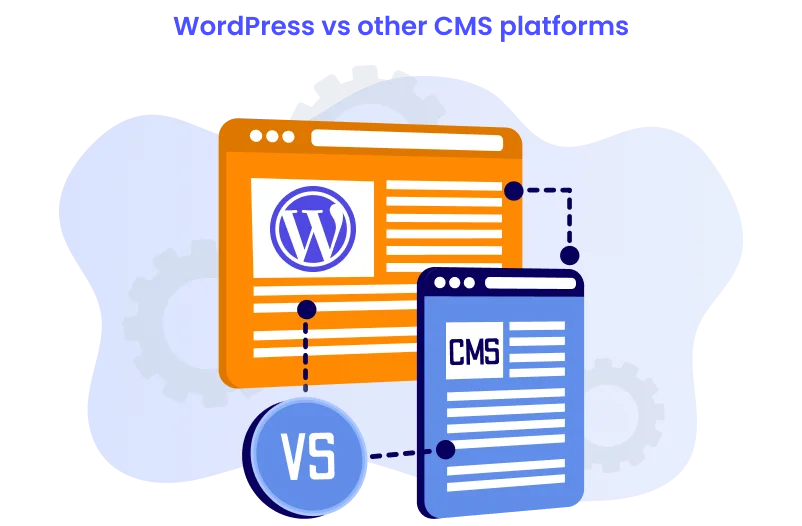
According to W3Techs data, roughly 43.4% of all websites run on WordPress. Among sites using a known CMS, that share climbs to 61.3%. This translates to somewhere between 480 and 520 million websites built on the platform.
To put that in perspective, the next largest platform is Shopify at 6.7%. Wix sits at 4.8%, Squarespace at 3.2%, and Joomla at 1.5%. It won’t be an overstatement to say that the gap is quite significant. Only websites without any CMS at all come close to WordPress, representing about 28.5% of the web.
Top CMS platforms: comparison table
| CMS Platform | Market Share |
| WordPress | 43.40% |
| Shopify | 6.70% |
| Wix | 4.80% |
| Squarespace | 3.20% |
| Joomla | 1.50% |
| No CMS | 28.50% |
Among the top 100,000 websites globally, WordPress also runs roughly 30%. These are high-traffic sites with serious technical requirements, and they seem to choose WordPress despite having the resources to build on any platform they want.
Why WordPress dominates the CMS market
At White Label Agency, we think that there are a couple of real reasons why WordPress maintains this lead, and that it didn’t happen by chance. Below, we’ll try to break down the three most important factors behind WordPress’ success.
Open-source flexibility
WordPress is open-source, which means the code is free and you can modify it however you need. This matters because you’re not locked into one company’s way of doing things. If you need a custom feature or a specific integration, you can build it. With closed platforms, you’re more limited to what they offer.
For marketing agencies, this flexibility can be especially beneficial. A client might need something specific that doesn’t fit into a template, and with WordPress, you can usually make it happen. With other platforms, there is a high chance that you may often have to explain why something isn’t possible.
Dedicated team
Scale your agency with a dedicated WordPress developer. With great communication, we make sure to keep your builds on track and on time.
A large ecosystem of plugins and themes
WordPress’s other advantage is its plugins. There are over 60,000 plugins available in the WordPress directory, and that’s not counting premium options. If you need to add e-commerce, WooCommerce is there. If you need SEO tools, there’s Yoast or Rank Math. Most common features already have a plugin for them, which saves time and money.
The theme ecosystem works the same way. You can start with a solid foundation rather than building everything from scratch. This tends to keep projects on schedule and costs predictable, which clients usually appreciate.
Community support and regular updates
WordPress also has one of the biggest and most active communities. A larger user base generally means problems get spotted and fixed faster. When a security issue appears, WordPress’s community tends to address it quickly. The platform has released more than 50 major versions since 2003, with updates rolling out roughly every six months.
We think that there’s a great value in knowing that the platform is actively maintained and that help is available whenever you run into problems. Smaller platforms don’t always have that same level of ongoing attention.
The future of WordPress from a 2026 perspective

When new site builders appear, they often come with features that WordPress doesn’t have yet. That’s usually how they try to stand out on the market. But we’ve noticed that WordPress always tries to respond to these changes, and it’s been fairly successful at keeping up with what people need.
The evolving Gutenberg Editor
One feature that newer website builders started offering was drag-and-drop editing. For a while, WordPress didn’t have anything quite like that, which made it harder for non-technical users to build pages visually.
The block-based Gutenberg editor represented WordPress’s answer to these drag-and-drop builders. It lets you build pages by adding and arranging blocks for text, images, buttons, and other elements. It’s not exactly the same as what Wix or Squarespace offer, but it’s moved WordPress in that direction. The editor has improved quite a bit since it first came out, and it now includes full-site editing, which extends the block approach to headers, footers, and entire page templates.
This way, WordPress addressed one of the main criticisms agencies used to have about it: that it wasn’t beginner-friendly enough for clients who wanted to make simple content updates themselves. While it’s not perfect, and some people still prefer other tools, the Gutenberg story is still a great example of how WordPress is willing to adapt when the market shifts.
Long-term reliability for marketing agencies
We believe that when you build on a platform that powers 43% of the internet, you’re making a safe bet. Our conviction is that WordPress isn’t going anywhere. The ecosystem is too large, the investment too significant, and the community too active for the platform to fade into irrelevance, even with the new AI tools appearing on the market.
Speaking of artificial intelligence, it’s also interesting that WordPress has already started making moves in the AI area. The platform has been testing AI-powered features for content creation and site building, responding to what other platforms are already doing. You can see some of this development in tools like the AI Assistant plugin and experiments with generative features in the editor.
Conclusion
Beyond market share and features, WordPress has proven itself as a platform that scales well. Small businesses using WordPress can start with a simple site and grow into something more complex without switching platforms.
Security is another area where WordPress has improved over the years. The platform’s popularity does make it a target, but that also means security vulnerabilities get attention quickly. Regular updates, a strong plugin vetting process, and a community that takes security seriously have made WordPress more secure than it used to be. For agencies managing client sites, this matters because it reduces risk and makes maintenance more predictable.
At the end of the day, WordPress has stayed relevant for over 20 years because it adapts. So we believe that for agencies that need a reliable platform with room to grow, it continues to be a solid choice.
Need help with WordPress?
If you’re building WordPress sites and need support with development, we’d be happy to help. At White Label Agency, we’ve worked with 600+ agencies over the past 13 years, building 10,000+ websites. Whether you need help with extra work or want to extend your team with dedicated WordPress developers, feel free to reach out to us, and we can discuss how we might be able to help your agency grow.