Color theory is a fundamental aspect of design, influencing everything from mood to brand identity. Within this framework, secondary colors play a pivotal role, bridging the gap between primary colors and expanding the designer’s palette.
These colors are essential elements on the color wheel and serve as key tools for crafting impactful designs. The purpose of this blog is to help you understand what secondary hues are, how they are created, and how you can use them effectively in your design projects to make them more visually appealing.

Secondary Colors: Overview
Secondary hues are created by mixing two primary colors. In traditional color theory, the primary colors are red, blue, and yellow. When combined, these foundational hues produce the three secondary colors – green, orange, and purple:
- Purple: The result of mixing red and blue, purple is often associated with luxury, creativity, and mystery. Its rich tones are perfect for adding depth and sophistication to a design.
- Green: Created by mixing blue and yellow, green represents nature, balance, and growth. It’s a versatile color widely used in designs that require a calming or refreshing tone.
- Orange: A vibrant mix of red and yellow, orange exudes energy, warmth, and enthusiasm. It’s a popular choice for creating designs that stand out and grab attention.
The Importance of Secondary Colors in Design
Secondary colors unlock a whole new dimension in design. They act as the bridge between the boldness of primary colors and the softness of tertiary colors (mixes of primary and secondary colors).
Harmonious Color Schemes
Secondary colors are integral to crafting balanced and visually appealing color schemes. By understanding the relationship between secondary and primary colors, designers can create harmonious palettes that resonate with the intended audience.
For example, purple pairs beautifully with yellow to create a striking contrast, while green can complement blue to evoke a sense of tranquility. As Anano, a White Label Agency (WLA) designer, says, “When you know how to balance between primary and secondary colors, you can create a visual harmony that guides the viewer’s eye exactly where you want it to go.”
WordPress Webdesign
Enhance your agency’s offerings with our WordPress website design services. Get custom, high-quality designs that fit your client’s needs.
Practical Applications
In practical design scenarios, secondary colors are used extensively across various mediums:
- Web Design: Secondary colors define key elements such as buttons, links, and navigation bars, guiding user interaction and improving the overall user experience. For instance, orange is often used for call-to-action buttons because it stands out against blue or white backgrounds, conveying energy and enthusiasm.
- Branding: Brands often use secondary hues to complement their primary color schemes, reinforcing brand identity and making their visual communication more dynamic. “In branding, secondary tones are like the supporting cast—they might not be the star, but they play a critical role in making the whole story work,” WLA’s Anano notes.
- Interior Design: Secondary palettes can transform spaces by setting the mood—whether it’s a vibrant orange for a lively space or a soothing green for a calm environment.
Visual Representation of Secondary Colors
Understanding how these colors fit into the broader spectrum of color theory is essential for any designer. That’s why we’ll now explore the concept of the color wheel, which visually represents the relationships between primary and secondary colors as well as tertiary colors. Additionally, we’ll look at real-world examples of popular designs that effectively use secondary colors to create memorable and impactful visuals.
The Color Wheel
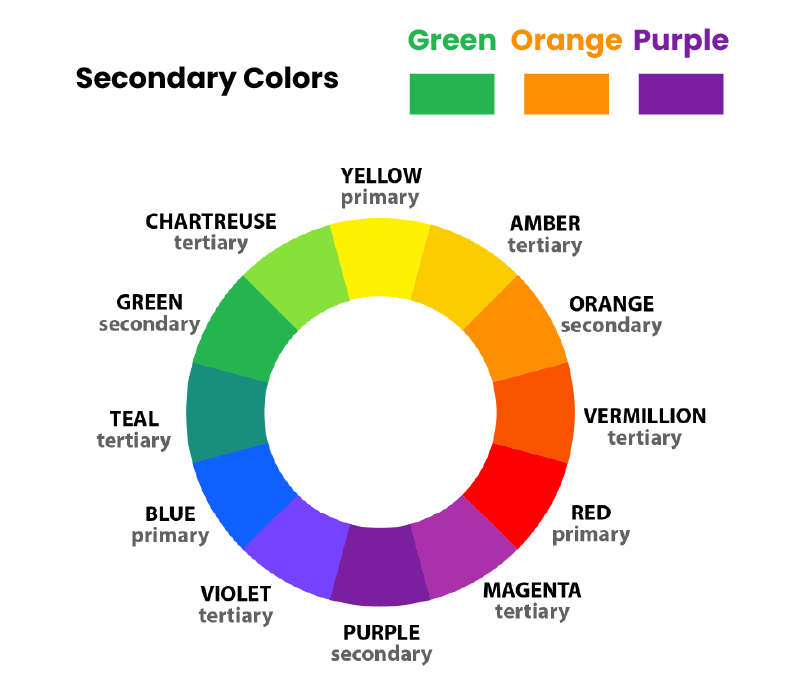
The color wheel is a fundamental tool in color theory that visually represents the relationships between colors. It’s a circular diagram where primary colors (red, blue, and yellow) are spaced evenly around the wheel. Secondary colors—green, orange, and purple—are positioned between the primary colors from which they are created, showing their direct connection. Tertiary colors, which result from mixing a primary color with a neighboring secondary color, fill in the spaces between them.
This arrangement helps designers understand how colors interact and complement each other, making it easier to create harmonious color schemes. Including an image of the color wheel can help readers better visualize the placement and relationship of secondary hues, offering a clearer understanding of how these hues fit into the broader spectrum.
Secondary Color Examples Among Famous Brands

Secondary hues are widely used in various well-known designs, websites, and logos, effectively showcasing their power in creating visually appealing and memorable aesthetics. Here are a few secondary color examples:
- Twitch Branding: Twitch, the popular streaming platform, uses purple as its primary brand color. Purple, being a secondary color, adds a sense of creativity and uniqueness, which resonates well with the brand’s identity as a platform for gamers and creators.
- Animal Planet Rebranding: In its rebranding, Animal Planet shifted to a refreshing green as its primary color. This green symbolizes nature, growth, and harmony, aligning with the channel’s focus on wildlife and environmental content.
- Firefox Logo: The Firefox logo utilizes a striking mix of orange and purple in its design. The orange fox encircling the blue globe effectively draws attention and conveys warmth and speed, while the purple adds a touch of creativity and sophistication.
When paired with neutral tones or bold backgrounds like black, as seen in black websites, secondary colors can create even more dramatic and eye-catching designs. This contrast helps secondary hues stand out, making them a valuable tool for web designers looking to make a lasting impression.
Tips for Using Secondary Colors in Design
Here are some helpful tips on how to use secondary colors effectively to achieve balance, contrast, and cohesion in your designs.
- Balance and Contrast: Achieving the right balance and contrast in a design often hinges on the thoughtful use of secondary hues. When paired correctly with primary colors, secondary hues can create a dynamic and visually appealing composition. For example, a bold orange can add energy to a primarily blue design, creating a striking contrast that draws attention.
- Combining with Other Colors: To create a cohesive design, consider how secondary tones interact with primary and tertiary colors. Experiment with different shades and tints of secondary colors to find combinations that enhance the overall aesthetic. Whether you’re working on a web design project or an interior space, the careful pairing of colors can lead to a more unified and effective design.
WordPress Web Design Agency
Partner with our white label WordPress web design agency for custom, scalable solutions. We design, develop, and maintain websites tailored to your clients.
Extra Tips on Using Secondary Colors in WordPress Design
As a WordPress developer or designer, secondary tones offer unique opportunities to enhance your projects:
- Creating Custom WordPress Themes with Secondary Colors: Consider using secondary tones as accent colors in custom WordPress designs. They can enhance user experience by guiding attention to key elements like buttons, links, and calls to action. For instance, using secondary color examples for hover states or active menu items can make your site more engaging.
- Integrating Secondary Tones with WordPress Block Editor: The WordPress Block Editor (Gutenberg) offers great flexibility in design. Customize block backgrounds with secondary colors to create visual separation, use secondary tones for quote blocks or custom button styles, and create color palettes that include your chosen secondary colors for easy access when designing.
Enhancing Website Branding through WordPress Design: Use secondary tones consistently across widgets, headers, and footers to reinforce brand identity. Incorporate secondary brand colors into custom post types or category indicators, and create a cohesive look by using secondary colors in featured images or graphic elements.
Conclusion
Secondary colors—green, orange, and purple—are fundamental to creating designs that are both visually appealing and balanced. By mastering the use of these colors, you can add depth, contrast, and harmony to your projects, whether you’re working on web design, branding, or any creative endeavor.
At White Label Agency, we’ve supported over 600 agencies by bringing their unique visions to life, and we have produced more than 10,000 websites. We specialize in crafting custom WordPress designs that are not only beautiful but also highly functional. If your agency is looking for additional design capacity or a reliable partner to enhance your WordPress projects, we’re here to help.
Let’s collaborate to create impactful websites that stand out. Contact us today to start your next project and elevate your design capabilities.
FAQs
Which 3 are the secondary colors?
The three secondary colors are:
Green – created by mixing blue and yellow.
Orange – created by mixing red and yellow.
Purple (Violet) – created by mixing red and blue.
These colors are derived from combining equal parts of two primary colors.
What are the 5 secondary colors?
Traditionally, there are only three secondary colors: green, orange, and purple (violet), as they are formed by mixing equal parts of the three primary colors (red, blue, and yellow). However, if you are referring to an expanded color model such as the RYB (Red, Yellow, Blue) or a digital color model like RGB (Red, Green, Blue), there might be additional intermediary hues considered as secondary or tertiary colors.
In some models, additional intermediate hues between primary and secondary colors might be included, but they are usually called tertiary colors. Here’s how you might see expanded secondary-like colors:
Yellow-green (mix of yellow and green)
Red-orange (mix of red and orange)
Blue-green (mix of blue and green)
Yellow-orange (mix of yellow and orange)
Red-purple (magenta) (mix of red and purple)
These are typically classified as tertiary colors rather than secondary colors.
What secondary color means?
A secondary color is a color that is created by mixing two primary colors in equal parts. In traditional color theory, primary colors (red, blue, and yellow) serve as the basis for all other colors. By combining any two of these primary colors, a secondary color is formed.
For example:
Green is created by mixing blue and yellow.
Orange is created by mixing red and yellow.
Purple (Violet) is created by mixing red and blue.
The term “secondary color” indicates that these colors are one step away from the primary colors and are foundational in creating more complex colors in the color spectrum. Secondary colors are essential in color mixing and are often used in art, design, and color theory to create visually appealing palettes.
In web design, which color is considered a secondary color?
In web design, secondary colors are created by mixing primary colors (red, blue, and yellow) and typically include green, orange, and purple. These colors add variety and depth to a color palette, complementing the primary colors to create a balanced design.
For example:
Green is a secondary color made by mixing blue and yellow.
Orange is created by mixing red and yellow.
Purple comes from mixing blue and red.
In web design, secondary colors are often used to highlight important elements, add contrast, or provide visual interest without overpowering the primary brand colors. Secondary colors are an essential part of a well-rounded color scheme and can be customized based on the website’s brand and goals.