
- What is White Label Copywriting?
- 3 Key Advantages of White Label Copywriting
- White Label Copywriting vs. Traditional Freelance Hiring
- 3 Challenges in White Label Copywriting (and How to Overcome Them)
- How White Label Copywriting Works
- Choosing the Right White Label Copywriting Provider
- Conclusion
- FAQs
Agencies face increasing demands for high-quality, consistent content across industries. However, for many, scaling content production while maintaining brand integrity can feel like a balancing act. This is where white label copywriting comes into play, offering a cost-effective solution for agencies that want to expand their content offerings without the overhead of hiring in-house writers.
In this blog, we’ll explore what a white label copywriting is, why it’s increasingly important for agencies, and how it compares to other content outsourcing models like freelance hiring. We’ll also provide insights into how agencies can successfully integrate white label copywriting into their operations, ensuring scalability, efficiency, and quality.
What is White Label Copywriting?
White label copywriting is a service where one agency creates content for another under the latter’s branding. The end client never sees the third-party provider; they only recognize the agency’s brand. This makes white label copywriting an appealing solution for digital marketing agencies, SEO firms, and businesses that need to deliver high-quality content without having the internal resources to scale production.
White Label Copywriting Service Fee Calculator

To evaluate the cost-effectiveness of this approach, let’s use the following formula to calculate in-house content production costs:
(Average writer salary + benefits + overhead) ÷ Average monthly word count
Let’s break this down with real numbers. Suppose an in-house writer earns $50,000 annually, with an additional $15,000 in benefits and $10,000 in overhead (equipment, office space, etc.). That brings the total annual cost to $75,000. If the writer produces 30,000 words per month, here’s how the math works out:
($75,000 ÷ 12 months) ÷ 30,000 words = $0.21 per word
Now, compare this to white label copywriting rates, which typically range from $0.06 to $0.28 per word. Depending on the complexity of the content, white label agency copywriting services can offer substantial savings, especially for less specialized projects.
For example, if you choose a white label provider charging $0.12 per word, you could cut your costs nearly in half while still delivering high-quality content. This allows agencies to scale efficiently while they outsource copywriting and avoid the overhead of maintaining a full-time writing team.
3 Key Advantages of White Label Copywriting
After understanding how cost-effective white label copywriting can be for scaling content production, let’s explore the broader impact it can have on your agency’s operations. Beyond just cost savings, white label copywriting introduces other strategic benefits that can transform how agencies manage and deliver content.

1. Effortless Scalability
One of the most significant advantages of white label copywriting is its ability to scale with your agency’s needs. Whether you need to ramp up production for a high-demand project or scale back during quieter periods, white label content outsourcing providers offer the flexibility to adapt quickly without the complexities of hiring, training, or managing in-house staff.
2. Access to Industry Expertise
White label providers bring specialized writers experienced in various niches, from healthcare to finance. This ensures that your agency can deliver high-quality, industry-relevant content, tailored to each client’s unique requirements. By choosing to outsource copywriting, you can tap into a pool of specialized expertise without the hassle.
3. Time and Resource Efficiency
By outsourcing content creation, your agency can focus on its core strengths—strategy, client relationships, and creative direction—while the heavy lifting of content production is handled externally. This not only saves time but also ensures that your internal team can deliver greater value where it matters most. When you outsource copywriting, it allows your team to stay agile and focus on strategic goals.
White Label Copywriting vs. Traditional Freelance Hiring
Despite all the benefits we’ve discussed and the advantages of an in-house team, one might wonder: why not just hire freelancers? Freelancers can be a great option depending on your agency’s needs and budget. However, the decision between white label copywriting and freelance hiring depends on several factors, such as scale, reliability, and management.
To help you decide, here’s a smart comparison table that highlights the key differences between white label agency copywriting services and freelancers based on different needs:
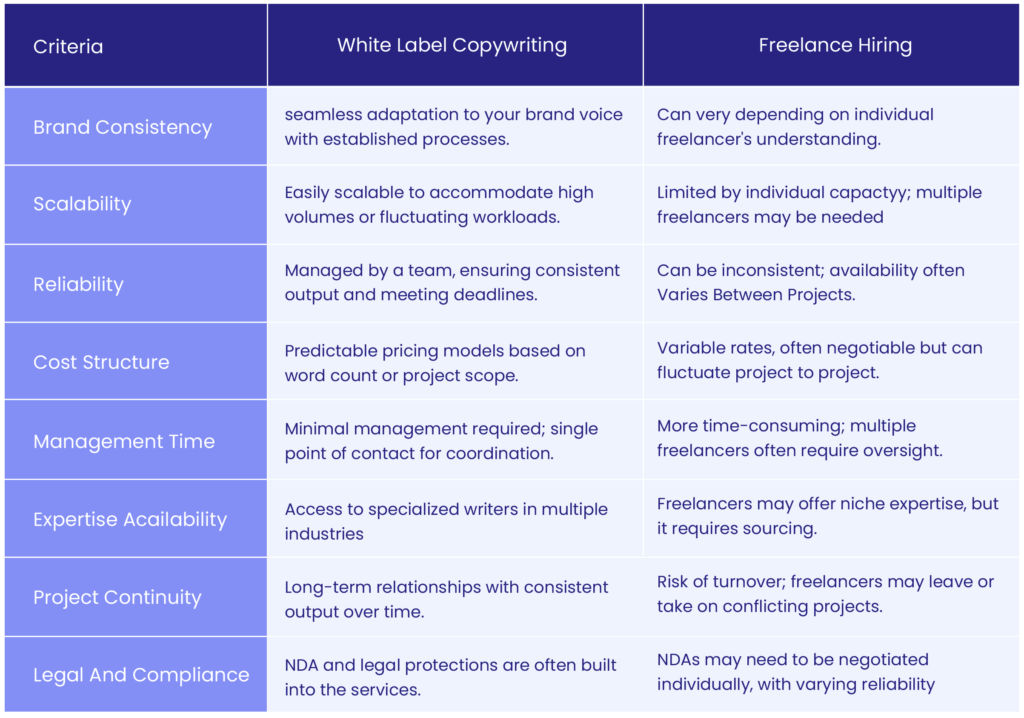
This table helps break down the core differences, allowing you to assess which option best aligns with your agency’s goals, workload, and management preferences. Whether you’re looking for consistency, scalability, or flexibility, both options have their strengths depending on your needs.
3 Challenges in White Label Copywriting (and How to Overcome Them)
While white label copywriting offers clear advantages, it also presents some challenges that agencies need to manage. By addressing these issues early on, you can ensure a smooth and successful partnership with your content outsourcing provider.
- Challenge: Maintaining Quality
Solution: To maintain quality, consider implementing a thorough onboarding process with your white label provider and establishing clear quality control measures.
- Challenge: Communication
Solution: For effective communication, use project management tools that allow real-time updates and set up regular video calls to discuss progress and address any issues promptly.
- Challenge: Protecting Sensitive Information
Solution: To protect sensitive information, utilize Non-Disclosure Agreements (NDAs). Here’s why they’re crucial:
- NDAs ensure the confidentiality of shared information, including client details and internal processes.
- They prevent the white label partner from disclosing their involvement, allowing your agency to take full credit for the work.
- NDAs often include clauses to prevent the provider from directly soliciting your clients or hiring away your team members.
To simplify the process, consider going through the White Label Agency (WLA) non-disclosure agreement example. Follow the link to download our free NDA template.
How White Label Copywriting Works
White label copywriting involves a specific process from start to finish. Understanding this workflow helps agencies effectively manage their content creation. Here’s a step-by-step breakdown of how white label copywriting typically functions:
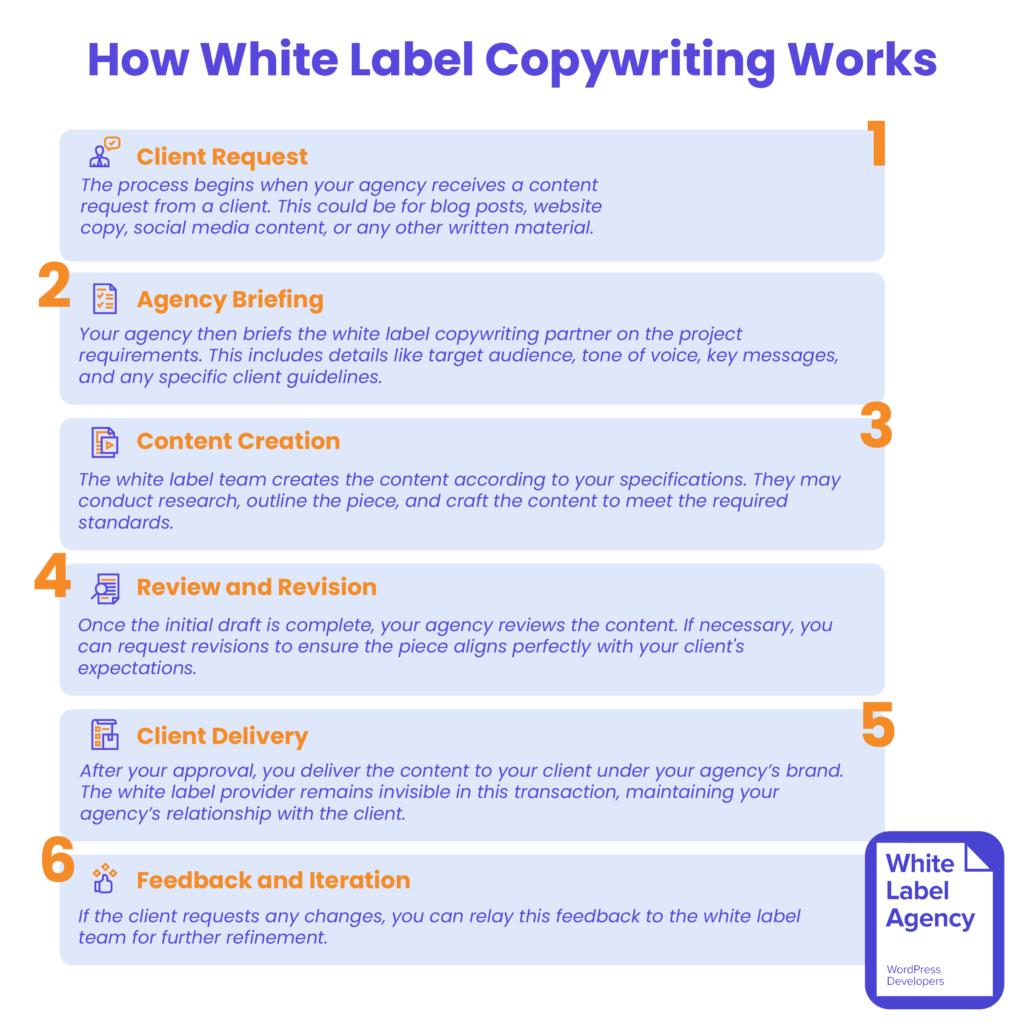
The key here is brand invisibility. Your clients never interact directly with the white label content outsourcing provider, ensuring that your digital agency retains full credit for the work that has been produced.
Want to learn more about the outsourced copywriting process? Check out our comprehensive guide on white label content creation.
Choosing the Right White Label Copywriting Provider

When selecting a white label copywriting partner, it’s crucial to go beyond surface-level evaluations. Here’s a streamlined, actionable approach to finding the right fit for your agency:
- Conduct a Thorough Content Audit
- Request 3-5 samples in different niches relevant to your clients
- Use a content scoring rubric (1-5 scale) to assess: a) Writing quality (grammar, clarity, flow) b) SEO optimization (keyword usage, meta descriptions) c) Tone and style adaptability d) Adherence to provided guidelines
- Test Real-World Performance
- Commission a small test project (e.g., a 500-word blog post)
- Set a reasonable deadline (e.g., 3 business days)
- Track actual delivery time and compare it to the promised timeline
- Dive Deep into Pricing and Scalability
- Calculate the cost per word for various content types
- Compare at least 3 providers using a spreadsheet
- Ask for their maximum weekly word count capacity
- Inquire about their process for handling a 50% increase in workload
- Verify Specialized Expertise
- For your top 3 client industries, ask: a) Number of writers with 2+ years experience in each b) Relevant certifications or qualifications of writers
- Request 1-2 writing samples specific to these industries
- Examine Quality Control Measures
- Ask for their QA process documentation
- Inquire about: a) Editor-to-writer ratio b) Specific plagiarism checking tools used (e.g., Copyscape) c) Error rate tolerance (e.g., <1% per 1000 words)
5 Critical Questions to Ask Potential Providers:

- Can you walk me through your revision policy, including the number of free revisions and turnaround time?
- How do you ensure white label compliance, including handling of writer credits and portfolio use?
- What specific SEO tools and strategies do you employ in content creation?
- Can you provide a sample content calendar and buyer persona for a hypothetical client?
- What data protection measures do you have in place, including the use of VPNs and confidentiality agreements?
By focusing on these specific, actionable steps and questions, you’ll gain a much clearer picture of each provider’s capabilities and fit for your agency’s needs.
Conclusion
White label copywriting offers a powerful solution for agencies looking to outsource copywriting efficiently without the overhead of managing an in-house writing team. By partnering with a white label provider, agencies can deliver high-quality, consistent content while retaining full brand ownership. This approach not only offers cost savings but also opens up opportunities for effortless scalability, access to industry-specific expertise, and increased time to focus on core business activities.
However, it’s important to carefully consider the right outsourcing model for your agency’s needs. As the comparison table demonstrates, white label copywriting offers distinct advantages over freelance hiring in terms of brand consistency, scalability, and management. But ultimately, your choice should align with your workload, budget, and the level of control you require.
Additionally, to ensure a successful white label partnership, implementing strategies such as effective communication, quality control, and the use of NDAs can protect your agency’s interests and client relationships. By choosing the right provider, securing agreements, and maintaining clear expectations, agencies can navigate potential challenges and maximize the benefits of white label copywriting.
FAQs
What are white label examples?
White label examples span various industries and services. Here are a few common ones:
White Label Software: Many companies offer software solutions, such as project management tools or CRM systems, that agencies can rebrand and sell under their own name. Examples include white-label platforms like ClickFunnels or Shopify, which are customized for agencies’ branding.
White Label Copywriting: Content agencies or freelance copywriters provide blog posts, social media content, website copy, or email marketing materials that other businesses can label as their own. This helps digital marketing agencies offer content services without hiring in-house writers.
White Label eCommerce Products: Manufacturers produce items (e.g., skincare products, apparel, or supplements) that other businesses can brand and sell under their own label. Amazon’s private label brands are a well-known example of this in eCommerce.
White Label SEO Services: Digital marketing agencies often partner with SEO specialists who handle technical SEO, backlinking, or on-page optimization, all branded under the agency’s name. White-label SEO allows agencies to offer a full suite of services without needing a dedicated SEO team.
White Label Mobile Apps: Some developers create customizable mobile app templates for various industries, which companies can rebrand and offer to their users as proprietary solutions. Food delivery apps and ride-sharing services sometimes operate under white-label models.
These examples allow businesses to expand their service offerings, enhance brand identity, and reach new markets without needing extensive in-house resources.
Is white labeling illegal?
No, white labeling is not illegal. It’s a widely accepted business practice where a product or service is produced by one company but rebranded and sold by another as its own. White labeling operates under legal agreements where both parties agree on terms, ensuring compliance with intellectual property rights, brand usage, and confidentiality.
The legality of white labeling hinges on adhering to certain practices:
Proper Agreements: Clear contracts should outline the terms, including ownership rights, responsibilities, and confidentiality clauses.
Compliance with Regulations: Products must comply with industry regulations, such as safety standards for physical goods or data protection laws for digital products.
Intellectual Property Respect: Both parties need to respect trademarks, copyrights, and other intellectual property rules to avoid legal conflicts.
So long as businesses follow these guidelines and are transparent in their agreements, white labeling is completely legal and can be a beneficial strategy for both the producer and the reseller.
How much does a copywriting agency cost?
The cost of hiring a copywriting agency can vary widely, depending on factors like the agency’s expertise, the type of content required, project complexity, and turnaround time. Here’s a general breakdown:
Basic Content (Blog Posts, Social Media): For standard blog posts, social media content, or basic website copy, agencies may charge $100 to $500 per piece or around $0.10 to $0.50 per word.
Premium Content (Long-Form Articles, SEO, Technical Writing): For more in-depth articles, SEO-focused content, or industry-specific writing, the cost typically ranges from $500 to $1,500 per piece. Complex topics requiring extensive research may push this range higher.
High-Level Marketing Copy (Branding, Ad Copy, Email Campaigns): For strategic copy, like brand messaging, ad campaigns, or email marketing sequences, agencies may charge $1,000 to $5,000 per project or more, depending on the campaign’s scale and expected ROI.
Retainer Models: Many agencies offer monthly retainers for ongoing work, often between $1,500 and $10,000 per month. This retainer usually includes a set number of content pieces, revisions, and consultations, offering a predictable, scalable solution for continuous content needs.
White Label Copywriting Services: If reselling under another brand, agencies might offer a discounted rate, but prices vary based on volume and exclusivity, typically ranging from $500 to $3,000 per month depending on service scope.
For a trusted partner that delivers high-quality, tailored content at competitive rates, consider working with The White Label Agency. We provide customized solutions that align with your brand and resonate with your audience, whether for one-time projects or ongoing content needs. Contact us to explore how our white-label copywriting services can help you expand your offerings and meet your clients’ content goals.
What it means to white label?
To “white label” means to produce goods or services by one company that are rebranded and sold by another company as if they created it. In a white-label setup, the producing company remains anonymous or invisible to the end customer, allowing the purchasing company to take full credit for the product or service.
White labeling is common in various industries and allows businesses to expand their offerings without developing products or services in-house. For instance, a digital marketing agency might partner with a white-label copywriting provider to deliver high-quality content under its own brand.
This practice saves time, reduces costs, and allows companies to focus on customer relationships and sales while leveraging the expertise of specialized providers.