You just finished a website project. The client loves it, but when you check the numbers, you barely broke even. Sound familiar?
Most agency owners struggle with pricing. They either charge too little and barely survive, or price too high and lose clients. The answer is simple: learn how to calculate markup properly.
Markup isn’t just adding extra money to your costs. It’s how you make sure every project pays for your overhead, your team, and leaves you with profit to grow your business.
In this guide, you’ll learn how to calculate markup, how to determine markup percentage, and how to calculate selling price using markup percentage. Whether you use a markup calculator or do it by hand, you’ll know exactly how to price your services profitably.
Understanding Markup in the Agency Context

Markup for agencies works differently than for retail stores. A store buys a shirt for $20 and sells it for $40. That’s simple. Agencies sell time, expertise, and creativity, which makes markup calculation more complex but also more important.
Markup is the amount you add to your direct costs to get your selling price. For agencies, direct costs include your team’s time, contractor fees, software, and project expenses. But markup also needs to cover everything else: rent, utilities, sales time, admin work, and profit.
Here’s why this matters: for every hour your team spends on client work, you probably spend 2-3 hours on non-billable activities like sales, project management, and admin tasks. Without proper markup, these costs eat into your profits.
Most agencies make these markup mistakes:
- Only calculating markup on billable hours
- Using different markup rates randomly across projects
- Guessing at prices instead of using markup formulas
- Not understanding their true costs
How to Calculate Markup: The Essential Formulas

Learning how to do markup calculations gives you control over your agency’s profitability. Let’s break down each formula with real examples.
Basic Markup Calculation Formula
The basic markup formula is:
Markup = Selling Price – Cost
Let’s say you’re building a WordPress website. Your costs are:
- Middle WordPress developer: 1 month at $3,900 (outsourced full-time dedicated developer)
- Internal designer: 20 hours at $60/hour = $1,200 (your in-house team)
- Project management: 15 hours at $60/hour = $900
- Tools and software: $200
- Total Direct Costs: $6,200
If you quote $12,400 for this project: Markup = $12,400 – $6,200 = $6,200
Your markup is $6,200. This covers your overhead, admin costs, and profit. But how do you know if this is enough? That’s where markup percentage helps.
How to Calculate Markup Percentage
Markup percentage shows you the relationship between your costs and markup. The formula is:
Markup Percentage = (Markup ÷ Cost) × 100
Using our WordPress example: Markup Percentage = ($6,200 ÷ $6,200) × 100 = 100%
This means you’re adding 100% to your direct costs. In simple terms, you’re doubling your cost basis to get your selling price.
Let’s look at different markup scenarios:
Low Markup (50%)
- Direct costs: $6,200
- Markup: $3,100
- Selling price: $9,300
Standard Markup (100%)
- Direct costs: $6,200
- Markup: $6,200
- Selling price: $12,400
Higher Markup (150%)
- Direct costs: $6,200
- Markup: $9,300
- Selling price: $15,500
The 50% markup might work for simple, high-volume projects. The 100% markup works for most custom agency work. The 150% markup fits specialized services or rush projects.
How to Calculate Selling Price Using Markup Percentage
This is the most useful markup skill. Instead of guessing prices, you can calculate exactly what to charge based on your target markup percentage.
The formula is:
Selling Price = Cost × (1 + Markup Percentage)
Let’s say you want a 120% markup on a brand and website package. Your costs are:
- Brand strategy: $1,500
- Senior designer: 1 month at $4,000 (outsourced full-time dedicated designer)
- Website development: Middle WordPress developer for 1 month at $3,900
- Total Direct Costs: $9,400
Your selling price calculation: Selling Price = $9,400 × (1 + 1.20) = $9,400 × 2.20 = $20,680
This systematic approach means you never accidentally underprice a project. You know exactly what you need to charge to hit your profit goals.
Markup Strategies for Different Agency Services
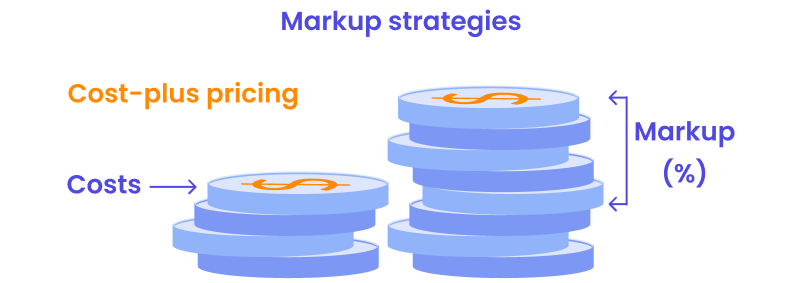
Not all services require the same markup approach. Different types of work have different cost structures, risk levels, and value propositions. Understanding how to adjust your markup strategy for each service type helps maximize profitability across your entire agency.
Creative Services Markup (Design, Branding)
Creative services often justify higher markup percentages because they deliver unique, strategic value that’s hard to replicate. When you’re creating a brand identity or designing a custom website, you’re not just selling hours, you’re selling creativity, strategy, and business impact.
For design work, consider these factors in your markup calculation:
- Revision rounds (clients always want changes)
- Creative exploration time
- Research and strategy phases
- Client education and presentation time
A typical branding project might look like this:
- Middle designer: 1 month at $3,200 (full-time dedicated designer)
- Strategy and research: $800
- Presentation materials: $300
- Total Direct Costs: $4,300
Using a 140% markup for creative services: Selling Price = $4,300 × (1 + 1.40) = $4,300 × 2.40 = $10,320
Hire a WordPress Designer
Discover the benefits of choosing to hire a WordPress designer. Enjoy focused attention, quick turnaround, cost-effectiveness, and expert design for the projects.
The higher markup accounts for the creative process, multiple concepts, revisions, and the strategic value you provide. Creative work also tends to have more unpredictable time requirements, so the extra markup provides a buffer.
Development Services Markup (WordPress, Custom Development)
Development services often have more predictable timelines and costs, which can allow for slightly lower markup percentages while still maintaining healthy profits. However, development projects carry technical risks that need to be factored into your pricing.
For a custom WordPress e-commerce site requiring 2 months of development:
- Senior WordPress developer: 2 months at $5,000/month = $10,000
- Testing and QA: $600
- Total Direct Costs: $10,600
Using a 110% markup for development: Selling Price = $10,600 × (1 + 1.10) = $10,600 × 2.10 = $22,260
Development markup should account for:
- Technical complexity and potential roadblocks
- Browser compatibility testing
- Device responsiveness testing
- Security considerations
- Future maintenance implications
Hire WordPress developer
Hire WordPress developer from our 150+ team. Scale your WordPress projects, without the hassle of recruiting a technical team.
Ongoing Services Markup (Maintenance, Retainers)
Ongoing services like website maintenance and monthly retainers operate differently. These services provide predictable revenue but often require immediate response capabilities and ongoing relationship management.
Let’s discuss this model with the example of our maintenance plans at WLA, as they demonstrate how agencies can structure ongoing services with proper markup. Our Small Maintenance Plan costs $899/month and covers up to 10 websites ($89 per site). If an agency resells this service, its markup calculation might look like this:
For a 10-website maintenance package:
- White Label Agency Small Plan: $899/month
- Your account management time: $200/month
- Client reporting and communication: $100/month
- Total Direct Costs: $1,199/month
Using a 95% markup for ongoing services: Selling Price = $1,199 × (1 + 0.95) = $1,199 × 1.95 = $2,338/month
This means you could charge clients around $234 per website per month while maintaining healthy profit margins.
Ongoing services can use slightly lower markup percentages because:
- Costs are more predictable
- You have recurring revenue
- Less sales effort is required after the initial setup
- Administrative overhead is spread across multiple months
The advantage of partnering with us for maintenance is that our transparent monthly pricing makes your markup calculations predictable, helping you build a sustainable recurring revenue stream.
WordPress maintenance plans
WordPress Maintenance Plans ensure site security, performance, and uptime. Choose custom plans with backups, monitoring, and unlimited content edits.
How to Do Markup Calculations in Practice

Understanding the theory behind markup is just the beginning. Successfully implementing markup strategies requires practical tools and consistent processes that work in real-world agency operations.
Using a Markup Calculator vs. Manual Calculations
Both markup calculators and manual calculations have their place in agency operations. Manual calculations help you understand the relationships between costs, markup, and pricing. However, markup calculators speed up the process and reduce errors during busy periods.
For quick estimates during client calls, a simple markup percentage calculator on your phone can be invaluable. Input your estimated costs, apply your standard markup percentage, and you have an instant ballpark price. This can be easily done for you by your in-house developer.
For detailed project pricing, manual calculations help you think through each cost component:
- List all direct costs (monthly developer rates, internal labor, tools, materials)
- Calculate your total cost basis
- Apply your markup percentage
- Review the final price for market reasonableness
Many agencies create simple spreadsheet templates that combine both approaches. You input your costs manually (ensuring you don’t miss anything), but the markup calculations happen automatically.
Building Your Own Pricing Framework
The most successful agencies develop their own pricing frameworks that go beyond simple markup calculations. This framework should include:
Standard Markup Percentages by Service Type:
- Creative services: 130-150%
- Development services: 100-120%
- Ongoing services: 90-110%
Cost Calculation Guidelines:
- Always include project management time
- Factor in revision rounds for creative work
- Add buffer time for technical challenges
- Include client communication time
- Use accurate monthly rates for dedicated developers
Pricing Decision Tree:
- Is this a rush project? Add 25% to standard markup
- Is this a new client? Consider competitive pricing for first project
- Is this a repeat client? Maintain consistent pricing
- Is this highly specialized work? Increase markup accordingly
Your framework should also include approval processes. For example, any project priced below 100% markup requires management approval. This prevents accidental underpricing while allowing flexibility for strategic decisions.
Conclusion
Mastering how to calculate markup is the difference between a struggling agency and a profitable business. The formulas are simple: markup equals selling price minus cost, and you can calculate selling price using markup percentage to work backward from your profit goals.
Apply markup consistently across all projects. Creative services typically need 130-150% markup, development services work at 100-120%, and ongoing services operate at 90-110%. Whether you use a markup calculator or do manual calculations, consistency is key.
Remember that markup isn’t just covering costs, it’s building a sustainable business. When you price correctly from the start, you avoid the feast-or-famine cycle that hurts many agencies.
For better markup strategies, consider partnering with specialized teams for WordPress development. Our transparent, predictable rates make your markup calculations more accurate and profit margins more reliable. Contact our team to learn how we can help make your pricing more predictable and profitable.
FAQ
How to find original price after markup percentage?
To find the original price when you know the selling price and markup percentage, use this formula:
Original Price = Selling Price ÷ (1 + Markup Percentage)
For example, if you sold a website for $12,400 with a 100% markup: Original Price = $12,400 ÷ (1 + 1.00) = $12,400 ÷ 2 = $6,200
This reverse calculation helps you analyze past projects and understand your actual cost basis.
What is a good markup percentage?
Good markup percentages vary by service type:
Creative services (design, branding): 130-150%
Development services (WordPress, custom coding): 100-120%
Ongoing services (maintenance, retainers): 90-110%
These ranges ensure you cover overhead costs, administrative time, and generate healthy profit margins. New agencies might start at the lower end and increase markup as they build reputation and expertise.
How to calculate markup percentage in Excel?
To create a simple Excel markup percentage calculator:
Put your cost in cell A1
Put your selling price in cell B1
In cell C1, enter this formula: =(B1-A1)/A1*100
This will automatically calculate your markup percentage. You can also create a template where you input costs and desired markup percentage, and Excel calculates the selling price using: =A1*(1+C1/100)
How to calculate margin?
Margin is different from markup. While markup is based on cost, margin is based on selling price:
Margin Percentage = (Selling Price – Cost) ÷ Selling Price × 100
For example, if your costs are $6,200 and selling price is $12,400: Margin = ($12,400 – $6,200) ÷ $12,400 × 100 = 50%
The same project with 100% markup has a 50% margin. Understanding both helps you communicate with clients and analyze profitability from different perspectives.