- What is White Label Web Design?
- White Label Web Design
- White Label Web Design vs. White Label Web Development
- 4 Benefits of White Label Web Design Services for Agencies
- Challenges of White Label Web Design (And How to Overcome Them)
- Comparing White Label Web Design with Other Options
- WordPress Webdesign
- How to Find the Right White Label Web Design Partner
- Real-World Use Cases: How Agencies Use White Label Web Design
- The Financial Side of White Label Web Design
- Conclusion
Want to offer web design services without the overhead of an in-house team? White label web design is the solution. By partnering with a trusted white label provider, you can scale your services, streamline operations, and offer a wider range of offerings to your clients.
This guide will walk you through everything you need to know about white label web design, from its benefits and challenges to tips for choosing the right partner.
What is White Label Web Design?

White label web design is an outsourcing model, that allows agencies to resell website design services under their own branding. Instead of building an in-house team, agencies can outsource the design process to a white label partner, who creates websites on their behalf. The end product is delivered with the agency’s branding, so clients never know a third party was involved.
This approach is ideal for digital marketing, SEO, and branding agencies looking to expand their offerings without the cost and effort of hiring full-time designers. It also ensures that agencies can focus on their core competencies while offering a full suite of services to clients.
White Label Web Design
Maximize your agency’s potential with our white label web design services. Deliver high-quality, branded websites without the need for an in-house team.
White Label Web Design vs. White Label Web Development
While often used interchangeably, white label web design and white label website development have distinct focuses:
- White Label Web Design primarily deals with the aesthetics, user experience, and visual aspects of a website. It involves creating the look and feel, layout, and overall user interface.
- White Label Web Development focuses on the coding, back-end functionality, and technical structure of a website. It involves bringing the design to life through programming and ensuring the website functions properly.
Both services are crucial and complement each other. In many cases, website design encompasses both design and development, offering a complete package. However, when referring specifically to web development, the design is usually already prepared.
4 Benefits of White Label Web Design Services for Agencies
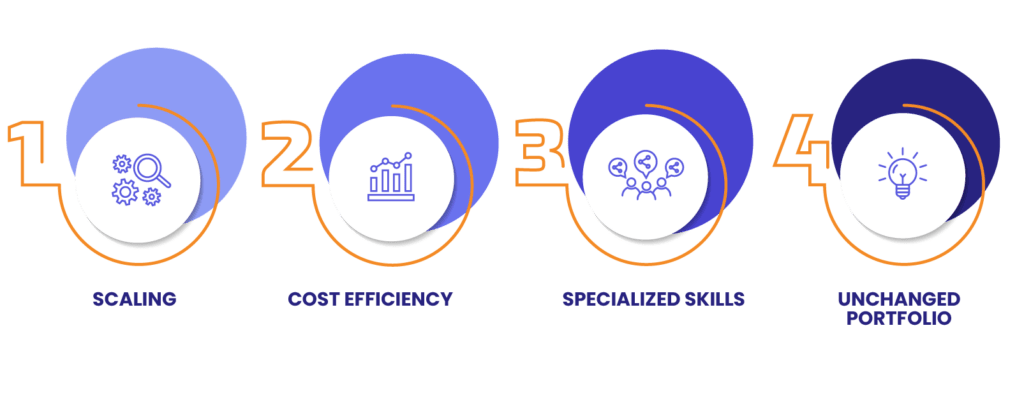
By working with a provider like WLA, your agency can act as a white label web design reseller, scaling its offerings while maintaining full control over client relationships. Below are 4 key benefits agencies can enjoy:
1. Scaling Services Without Hiring Full-Time Designers
White label web design allows agencies to expand their website design services without the need to hire and manage a full-time, in-house design team. By outsourcing design work to a trusted white label partner like WLA, agencies can handle more projects and meet the growing demands of their clients without incurring additional overhead costs. This flexibility means that agencies can take on more clients without the hassle of recruitment, training, or maintaining an in-house design team.
2. Cost Efficiency and Increased Profit Margins
Outsourcing to a white label design agency helps agencies save on labor costs and operational expenses, significantly improving profit margins. Since the white label partner handles the bulk of the design work, agencies can offer high-quality website design services to their clients at a competitive price while keeping internal costs low. This allows agencies to maintain strong profitability, especially when compared to the higher expenses involved in maintaining an in-house design team.
3. Access to Specialized Skills and Fast Turnaround Times
A white label design agency typically has a team of skilled designers with expertise across a variety of web design platforms, tools, and industries. By partnering with white label digital agency, you gain access to specialized skills that may not be available internally.
This means faster project turnaround times and the ability to deliver high-quality, professional websites on time and within budget. The ability to meet tight deadlines and manage multiple projects simultaneously allows agencies to scale efficiently without sacrificing quality.
4. Enhancing Your Portfolio and Strengthening Your Brand
White label services provide agencies with the opportunity to offer a wider range of services under their own brand, ultimately strengthening their portfolio. By delivering custom, professional website designs that align with the client’s branding, agencies can showcase a diverse array of completed projects.
This helps agencies attract new clients, retain existing ones, and present themselves as a full-service provider. Since the white label partner remains invisible, the agency gets full credit for the work, which boosts its reputation and brand perception.
Recommendation:
Access our white paper to discover 10 tips for the best website design.
Challenges of White Label Web Design (And How to Overcome Them)
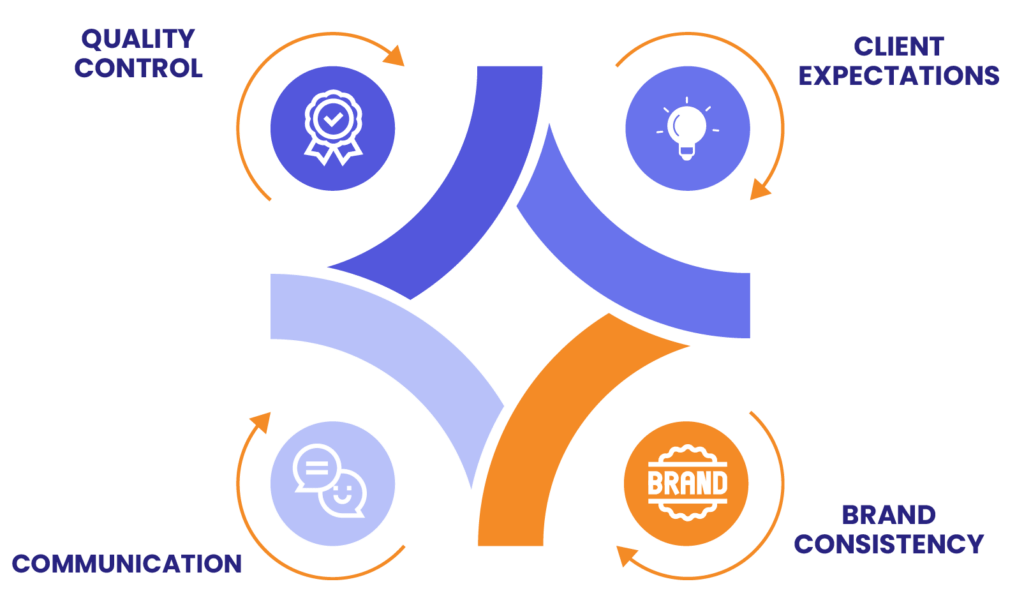
While the benefits of white label design are clear, it’s important to acknowledge that outsourcing can also come with its own unique challenges. However, with the right strategies in place, these hurdles can be effectively managed, ensuring a smooth partnership and consistent delivery of high-quality projects. Below are some common challenges agencies face when working with white label design services and practical tips on how to overcome them.
Quality Control Concerns
Maintaining consistent quality can be challenging when outsourcing, especially if the design standards between your agency and the white label partner differ.
How to Overcome This: Establish clear, non-negotiable quality standards at the outset of the partnership. Set up a detailed quality assurance process that includes multiple review stages before a project is delivered. Regular check-ins with your partner are crucial—schedule progress updates and provide specific feedback during these touchpoints to ensure the final product meets your expectations.
Tip: Create a quality control checklist that both your internal team and the white label provider can follow. This ensures everyone is aligned on what constitutes a “finished” and acceptable product.
Managing Client Expectations
Clients may not fully understand the white label process, which can lead to confusion about timelines and deliverables, especially if they expect real-time updates on their projects.
How to Overcome This: Transparent communication is essential. Set clear expectations from the start by outlining the project scope, timeline, and key milestones. Let your clients know when they can expect progress updates and final deliverables. This helps avoid scope creep and keeps everyone on the same page.
Tip: Use client-facing project management tools like Trello or Asana, where clients can track the progress of their projects in real time. This keeps them informed without overwhelming them with details, improving their confidence in your process.
Communication Barriers with Your White Label Partner
Effective collaboration with your white label website design partner can be difficult if communication channels are unclear or inconsistent, leading to misunderstandings and delays.
How to Overcome This: Implementing the right project management tools is key to minimizing communication barriers. Platforms like Basecamp or Monday.com allow for seamless communication, file sharing, and task tracking between your team and your white label partner. Regular video meetings and check-ins can also help maintain a personal connection and ensure that all parties are aligned on project goals and timelines.
Tip: Establish a communication protocol that includes preferred channels, response times, and a clear point of contact for both teams. This reduces miscommunication and helps resolve issues faster.
Ensuring Brand Consistency
When working with a third-party provider, there’s a risk that the design might not fully align with your agency’s brand identity, which can impact how your clients perceive your work.
How to Overcome This: Provide your white label partner with detailed brand guidelines that outline everything from color schemes to aesthetic fonts and image use. These guidelines should be comprehensive and specific to ensure that every design reflects your agency’s standards.
Tip: Conduct a remote brand workshop with your white label team before starting any projects. This will ensure that they understand your agency’s vision and can apply your brand’s aesthetic consistently across all projects.
Comparing White Label Web Design with Other Options

While white label web design services offer clear benefits for scaling agencies, it’s not the only option. Agencies often weigh the pros and cons of working with an in-house design team, freelance designers, or standard outsourcing. Understanding the differences between these approaches will help you make the right choice for your business.
In-House Design Team vs. White Label Web Design Services
Hiring an in-house design team gives you direct control over every aspect of the design process. Your designers are fully integrated into your agency’s culture, allowing for seamless communication and alignment with your brand. However, this comes with a high cost, including salaries, benefits, and the ongoing need to train and retain top talent.
On the other hand, partnering with a white label website design agency provides flexibility. You can scale up or down based on project demand without the financial burden of maintaining full-time staff. Additionally, white label web design services give you access to a broader range of expertise without long-term commitments. This allows your agency to focus on its core competencies while delivering high-quality website design under your brand.
Key Considerations:
- In-House Team: Direct control, but high costs and resource-intensive.
- White Label Partnership: Cost-effective, scalable, and access to specialized skills, but requires strong communication with your partner.
WordPress Webdesign
Enhance your agency’s offerings with our WordPress website design services. Get custom, high-quality designs that fit your client’s needs.
Freelance Designers vs. White Label Partnerships
Freelance designers can offer a more flexible, budget-friendly solution for agencies that only need occasional web design work. Freelancers tend to be more affordable than an in-house team, but the downside is that finding reliable and consistent freelancers can be time-consuming. Additionally, freelancers might not always be available when needed, which could cause delays in project timelines.
In contrast, a white label agency provides a dedicated team of designers who work under your brand. With white label design services, you have guaranteed access to a larger pool of talent and the ability to scale as needed. This helps ensure that project timelines are met consistently, and the work aligns with your brand’s quality standards.
Key Considerations:
- Freelancers: Cost-effective for short-term or small projects, but reliability and availability can be issues.
- White Label: More reliable and scalable for ongoing work, with less risk of inconsistent quality.
Outsourcing vs. White Labeling: What’s the Difference?
Both outsourcing and white label web design involve external partners completing work for your agency. However, the key difference is branding. In traditional outsourcing, the third-party provider may interact with your clients, and the work is often delivered under the outsourcing company’s name. With white labeling, the design services are provided under your agency’s brand, and your clients are unaware that a third-party partner is involved.
This makes white label website design ideal for agencies that want to maintain complete ownership of client relationships and brand image while leveraging external expertise.
Key Considerations:
- Outsourcing: More transparency with clients about external involvement but less control over branding.
- White Labeling: You retain full ownership of the client relationship, with seamless integration of services under your brand.
How to Find the Right White Label Web Design Partner

To be a successful white label web design reseller, finding the right partner is crucial. The right white label partner will help you scale efficiently while maintaining the quality your clients expect. Here are the key qualities to look for when selecting your partner.
Key Qualities to Look for in a White Label Web Design Partner
- Proven Expertise: Look for a white label partner with a solid track record. Ask for case studies or portfolios to see their work and make sure they have experience in your industry.
- Transparent Communication: Clear and open communication is essential for a successful partnership. Your white label partner should be responsive, offer regular updates, and be proactive in addressing any concerns.
- Quality Assurance Processes: Ensure your partner has a robust quality assurance process in place. This should include multiple review stages before the final product is delivered to ensure consistency with your agency’s standards.
- Scalability: Your partner should have the ability to scale up or down based on your project load, providing the resources needed to meet tight deadlines without compromising quality.
The Importance of a Trial Project Before Full Partnership
Before fully committing to a white label service provider, it’s wise to start with a trial project. This allows you to evaluate their communication, work quality, and turnaround times. A trial project provides insight into whether the partner can meet your expectations and seamlessly integrate with your existing processes.
Tip: Use a small, non-time-sensitive project for the trial to see how well the partner handles each stage of the process.
Evaluating Pricing Structures and Contracts
Pricing structures can vary between white label agencies, so it’s important to understand how your potential partner charges for their services. Some agencies may offer flat-rate pricing per project, while others might charge based on the complexity of the work or a monthly retainer for ongoing services.
When reviewing contracts, ensure that the pricing aligns with your agency’s financial goals and that the agreement is flexible enough to accommodate fluctuations in project volume.
Tip: Look for transparent pricing models that include all deliverables to avoid unexpected costs later on.
6 Questions to Ask Potential Partners

Before signing a contract with a white label web design reseller, ask the following questions to ensure they are the right fit for your agency:
- What is your experience working with agencies in our industry?
- How do you handle project management and communication?
- What quality assurance processes are in place?
- Can you scale your team based on our project load?
- What are your typical turnaround times for projects?
- What pricing model do you use, and are there any hidden fees?
These questions will help you gauge whether the white label partner can meet your needs and align with your agency’s goals.
Recommendation:
Download our free non-disclosure agreement template for a safer white label partnership.
Real-World Use Cases: How Agencies Use White Label Web Design

To illustrate the value of white label design in practice, let’s explore a real-world example of how a digital agency partnered with White Label Agency (WLA) to scale their services. For confidentiality reasons—since this is a white label partnership where the end-client is unaware of WLA’s involvement—we’ll refer to the agency as SEO Agency.
Case Study: How SEO Agency Expanded Their Design Services with White Label Partnership
Note: Due to our non-disclosure agreement, we’ll refer to this client as “SEO Agency” to protect their privacy.
The Client
A fast-growing digital marketing agency specializing in SEO and branding services for small and mid-sized businesses. With a strong reputation in digital marketing, they faced increasing client demands for web design services but lacked the internal resources to fulfill these requests.
The Challenge
The agency faced three critical issues:
- Rising client demand for web design services
- No in-house design team
- Budget constraints making full-time designer hiring unfeasible
They needed a solution that would allow them to:
- Offer professional web design services
- Maintain their brand identity
- Keep operations cost-effective
- Ensure seamless client experience
The White Label Design Solution
After careful consideration, the agency partnered with White Label Agency (WLA) to provide white label web design services. The partnership began with a test project for a prominent retail client.
How It Worked:
- The agency handled all client communications
- They provided WLA with comprehensive project briefs including:
- Design preferences
- Brand guidelines
- Technical requirements
- WLA’s team executed the designs under the agency’s brand
- The agency maintained full control of client relationships
6-Month Results
The partnership transformed the agency’s operations:
- 🚀 40% Faster Project Delivery:
From 8 weeks to just under 5 weeks per project - 📈 65% Improvement in Team Efficiency
Teams could handle more projects simultaneously - 💰 35% Reduction in Project Costs
Compared to the estimated costs of hiring in-house designers
The Financial Side of White Label Web Design
When considering white label web design, it’s essential for agencies to understand how to price these services to maintain profitability while delivering value to their clients. There are various pricing models to consider, each with its own advantages. Let’s break down the options and provide insights into developing a profitable strategy.
Pricing Models: Markup vs. Margin for White Label Web Design
Agencies typically use one of two pricing models when they want to resell web design services: markup or margin.
- Markup: In this model, the agency takes the cost of the white label web design service provided by the white label agency and adds a percentage on top as profit. For example, if a white label provider charges $1,000 for a custom website design, the agency might mark it up by 50%, charging the end-client $1,500. This model is straightforward, making it easy to calculate profits.
- Margin: With a margin-based model, the agency calculates the desired profit margin and sets the price accordingly. For instance, if the agency wants a 30% profit margin, they would price the service such that 30% of the final sale price is profit. Using the same $1,000 cost example, the agency would charge the client roughly $1,429 to achieve this margin.
Which One to Use:
Choosing between markup and margin depends on the agency’s pricing strategy and market positioning. Markup is easier to implement, especially for smaller projects, while margin allows for more control over profit in larger projects or with more price-sensitive clients.
How to Create a Profitable Pricing Strategy for White Label Website Design
To develop a profitable pricing strategy for white label web design, agencies need to consider several factors:
- Understand Your Market: Research what competitors are charging for similar services. This will give you a baseline for setting your own prices while ensuring they align with the value you’re offering.
- Account for Overheads: While outsourcing design work to a white label agency keeps costs down, you’ll still need to factor in other expenses, such as project management, communication, and quality assurance on your end.
- Add Value with Premium Services: Consider bundling your white label web design services with other offerings such as SEO or website maintenance plans. Clients are often willing to pay more for comprehensive packages that deliver long-term value.
- Offer Flexible Pricing: Create tiered pricing packages to cater to different client needs. For example, offer basic, standard, and premium packages based on the complexity and customization of the design.
Recommendation:
Want to calculate your potential ROI? Try WLA’s ROI calculator for digital agencies, to see how white label services can boost your bottom line.
Conclusion
White label web design offers agencies the perfect opportunity to scale their services, expand their client base, and increase profitability—all without the need to hire an in-house design team. By partnering with a trusted provider like White Label Agency (WLA), you can confidently offer high-quality web design services under your own brand.
If your agency is looking to grow without taking on the overhead of new hires, white label web design is a smart, scalable solution. White Label Agency has partnered with over 600 satisfied agencies, delivering more than 3,000 white label projects each year.
Ready to take the next step? Contact us to learn more about how WLA can help your agency thrive with our expert white label services.