- Benefits of Outsourcing Web Development
- Challenges and Risks of Web Development Outsourcing
- Choosing the Right Outsourcing Model
- How to Find and Evaluate a Web Development Outsourcing Partner
- Steps to Outsource Web Development Effectively
- Managing the Web Development Outsourcing Process
- Cost of Outsourcing Web Development
- Common Mistakes in Web Development Outsourcing and How to Avoid Them
- Case Studies and Success Stories
- Future Trends in Web Development Outsourcing
- Conclusion
To stay competitive in today’s digital landscape, many agencies choose to outsource web development. This strategic business practice involves delegating web development tasks to an external partner, allowing agencies to optimize their operations and focus on core business activities.
Outsourcing web development services has become increasingly popular among digital agencies due to the flexibility and access to global talent it provides. By partnering with a web development outsourcing company, agencies can enhance their service offerings and more effectively manage their resources, all while avoiding the high costs associated with maintaining an in-house development team.
Commonly outsourced web development services include: website design, front-end and back-end development, e-commerce platforms, content management systems (CMS) like WordPress, and specialized tasks such as mobile app development or advanced technology integration. As the digital landscape continues to evolve, the decision to outsource web development remains a valuable option for agencies looking to stay competitive and meet the growing demands of their clients.
In the chapters ahead, we’ll explore the specific benefits of outsourcing web development, guide you through selecting the right web development outsourcing company, and offer best practices for managing the web development outsourcing process effectively. Whether you’re considering outsourcing for the first time or looking to refine your current approach, this guide will provide the insights you need to make informed decisions and drive your agency’s success.
Benefits of Outsourcing Web Development
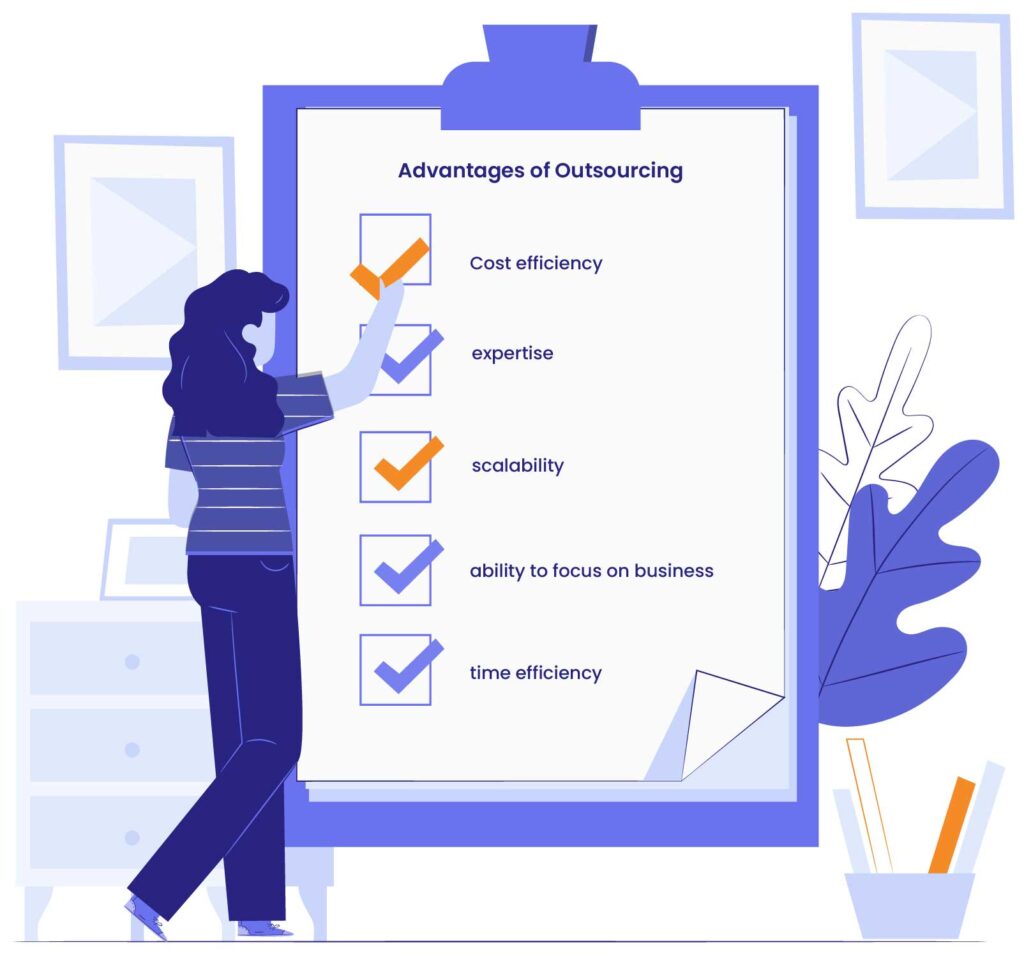
Outsourcing web development offers a variety of strategic advantages for digital agencies, making it increasingly attractive in the industry. By partnering with external experts, agencies can streamline their operations and deliver projects more efficiently. Let’s explore the key benefits that make outsourcing a popular option for many businesses.
Cost Efficiency
One of the primary reasons agencies consider outsourcing web development services is the potential for significant cost savings. When you outsource web development, you can avoid the substantial expenses associated with maintaining an in-house team. These costs go beyond just salaries and include recruitment, training, benefits, office space, and equipment. Overall, the total cost of an in-house employee can be 1.25 to 1.4 times the base salary when considering these additional expenses.
By partnering with a web development outsourcing company, you can access skilled developers on a project basis or for specific periods, paying only for the work you need. This allows you to manage your budget more effectively and offer competitive pricing to your clients while maintaining healthy profit margins.
In addition, outsourcing also provides the opportunity for flexible employment. “Hiring full-time remote WordPress developers from an agency gives you the ability to cancel contracts on fairly short notice and to add more people to your team when you need to scale up,” explains White Label Agency (WLA) CEO Einar Rosenberg.
Access to Expertise
Another one of the key benefits that you get when you outsource web development is access to a global pool of talent with diverse skills and experiences. This is particularly beneficial when your agency requires expertise in specific technologies or frameworks that may be challenging to find or costly to maintain in-house.
For instance, you might need a developer with expertise in React.js for one project, and a WordPress specialist for another. When you outsource web development, you can tap into these specialized skills as needed, ensuring that each project is handled by the professionals with the most relevant experience. This access to a wide range of expertise can significantly enhance the quality of your deliverables and your agency’s overall capabilities.
WordPress developer for hire
Are you struggling to find the right WordPress developer for hire? Our staff of 100+ WordPress developers is available for your projects.
Scalability
If your agency experiences seasonal or cyclical demand for web development services, choosing to outsource web development can provide greater flexibility. During peak periods, you can quickly ramp up your development capacity to handle multiple projects simultaneously. Conversely, during slower periods, you can scale down without the concerns of layoffs or maintaining an underutilized staff.
This scalability allows you to take on a wider range of projects and respond swiftly to market opportunities. It’s easier to add or remove team members when you need to quickly respond to shifts in the market. As Edwin Van der Maas, co-owner of the web development agency 2manydots, said after partnering with WLA’s outsourcing services, “It’s a flexible layer that can grow, it can scale as big as you want it to be.”
Focus on Core Competencies
By choosing to outsource web development, your agency can focus on its core strengths and strategic growth initiatives. Rather than dedicating valuable resources to managing technical operations, you can concentrate on areas that directly drive your business forward, such as client relationships, marketing, and service innovation.
For example, if your agency specializes in branding and design, the decision to outsource web development will allow your team to focus on creating compelling visual identities and user experiences. This specialization can lead to improved service quality, increased client satisfaction, and ultimately, business growth.
Time Efficiency
Choosing to outsource web development can significantly accelerate project timelines, allowing you to deliver results to clients faster. Specialized teams from a web development outsourcing company are often able to start work immediately and can dedicate focused effort to your projects. Moreover, by leveraging time zone differences, you can potentially achieve round-the-clock development, further speeding up delivery times.
This time efficiency is crucial in the fast-paced digital landscape, where rapid deployment can be a key competitive advantage. By delivering projects more quickly, you can improve client satisfaction, take on more work, and stay ahead of market trends.
Challenges and Risks of Web Development Outsourcing
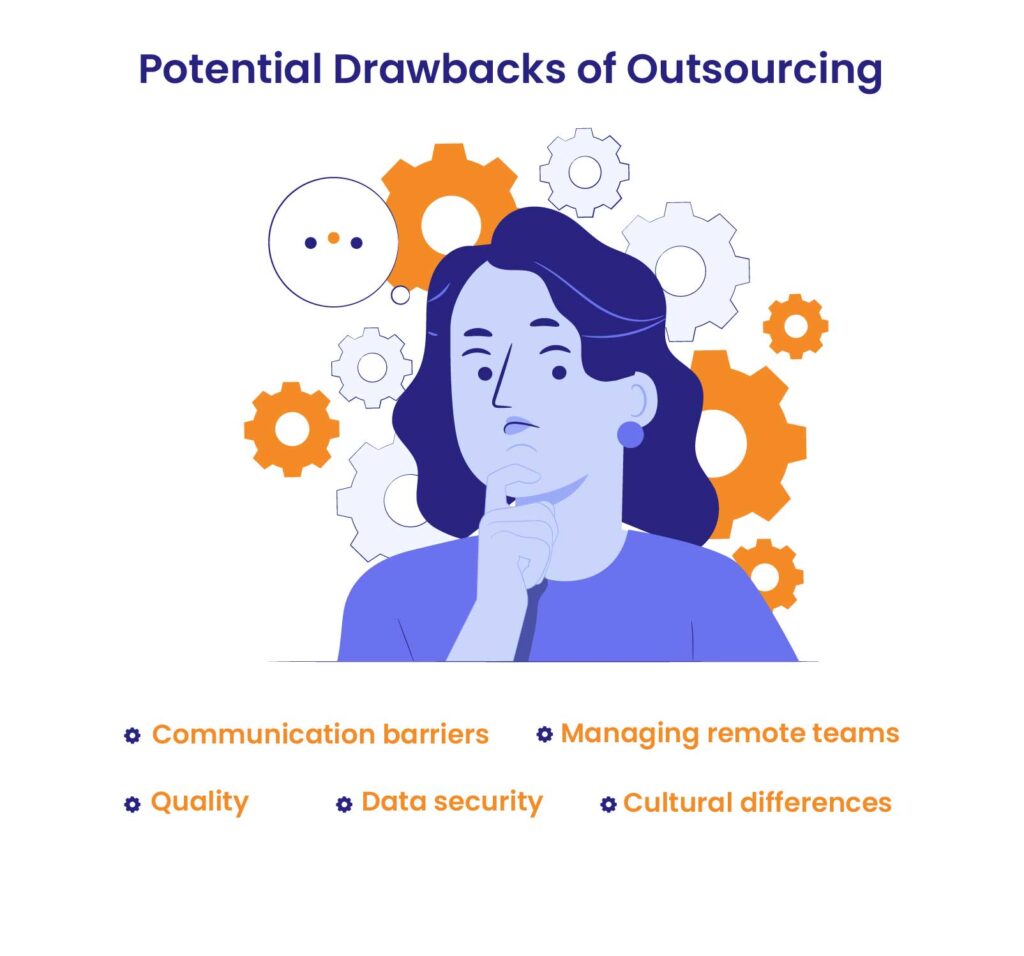
While outsourcing offers numerous benefits, it’s important to be aware of potential challenges:
- Communication Barriers: Language differences and time zone disparities can pose challenges in outsourced projects. It’s crucial to establish clear communication protocols and use appropriate tools to overcome these barriers.
- Quality Assurance: Ensuring high-quality outcomes in outsourced projects requires setting up robust quality control processes. This is essential to maintain your agency’s reputation and meet client expectations.
- Data Security: Protecting client data and intellectual property is paramount when you outsource web development. Implementing best practices for maintaining security in outsourced work is crucial.
- Cultural Differences: Understanding and managing cultural gaps between teams can be challenging but is necessary for smooth collaboration.
- Managing Remote Teams: Effective remote team management requires specific skills and tools. Agencies need to adapt their management style to work effectively with outsourced teams.
Choosing the Right Outsourcing Model
When you decide to outsource web development, selecting the right outsourcing model is crucial to the success of your project. Different models offer varying levels of flexibility, control, and cost-efficiency, making it essential to match the model to your specific project needs.
Overview of Outsourcing Models
There are four primary models of outsourcing web development services: fixed-price, time & materials, dedicated team, and hybrid models.
- Fixed-Price Model: In this model, the scope, timeline, and cost are agreed upon upfront. It’s ideal for projects with well-defined requirements where changes are unlikely. The primary advantage of the fixed-price model is budget predictability, but it can be rigid if unexpected changes arise during the development process.
- Time & Materials Model: This model is based on the actual time and resources spent on the project. It offers flexibility, making it suitable for projects where the scope may evolve over time. However, this model can lead to higher costs if not carefully managed.
- Dedicated Team Model: In this model, an entire team is allocated to work exclusively on your projects. This approach provides the highest level of control and consistency, making it ideal when you outsource web development for long-term or complex projects. While more expensive, it ensures that the team is fully immersed in your project, leading to better alignment with your goals.
- Hybrid Model: Combining elements of the fixed-price and time & materials models, the hybrid approach offers a balance between flexibility and cost control. It allows you to define certain project components with fixed prices while leaving room for adjustments in other areas.
How to Select the Best Outsourcing Model
Choosing the right model when you outsource web development depends on several factors, including project type, budget, and timeline.

- Project Type: For projects with a clear scope and well-defined requirements, the fixed-price model is often the best choice. However, if your project is complex or likely to evolve, the time & materials or hybrid models may be more appropriate. A dedicated team is ideal for ongoing projects that require a high degree of collaboration and expertise.
- Budget: If budget predictability is your top priority, the fixed-price model offers the most security. However, if your project requires flexibility, you may need to allocate a more fluid budget under the time & materials or hybrid models. The dedicated team model, while more costly, ensures that your project gets the focused attention it needs, which can be more cost-effective in the long run.
- Timeline: Consider the project timeline when selecting a model to outsource web development. If you have a tight deadline, a dedicated outsource web development team may be the best choice due to their focus on your project. On the other hand, if you can afford a more extended timeline, the time & materials or hybrid models offer the flexibility to adapt as the project progresses.
How to Find and Evaluate a Web Development Outsourcing Partner
When selecting a web development outsourcing company, consider the following factors:
- Technical expertise;
- Portfolio quality;
- Client testimonials;
- Industry experience.
A partner with experience in your industry will better understand your needs and be able to deliver more tailored solutions. Before you outsource web development, it’s essential to review their past projects and seek client feedback to gauge their reliability and quality of work.
WordPress Development Agency
Experience WordPress development with our custom-coded websites. Perfect for agencies, our reliable service ensures timely delivery and client satisfaction.
Questions to Ask Potential Partners
To assess the suitability of a web development outsourcing company, ask key questions such as:
- What is your experience with similar projects?
- How do you handle project management and communication?
- What security measures do you have in place to protect client data?
Their responses will provide insight into their processes, reliability, and how well they align with your agency’s needs.
Red Flags to Watch Out For
When you outsource web development, be wary of potential red flags such as poor communication, lack of transparency, or overly low pricing, which may indicate subpar quality. Additionally, partners who are unwilling to provide detailed proposals or hesitate to discuss previous projects should be approached with caution.
Verification Process
Before finalizing a partnership to outsource web development, conduct thorough due diligence. This includes verifying the technical skills of the team, checking references, and possibly starting with a small test project to assess their capabilities. Ensuring that the outsourcing partner meets your standards before committing to a full project can save time and resources in the long run.
Steps to Outsource Web Development Effectively

Let’s now dive into some practical tips to get your outsource web development project off the ground and keep it on track.
Defining Project Scope and Goals
Clear and detailed documentation is critical to the success of outsourced projects. When you outsource web development, defining the project scope, goals, and deliverables upfront sets the foundation for a successful collaboration. Clear documentation helps prevent scope creep and ensures that both parties have a shared understanding of the project’s objectives.
Creating a Detailed Project Brief
A comprehensive project brief is essential when you outsource web development. It should include the project’s purpose, target audience, technical requirements, design guidelines, and timelines. Providing detailed information will help the outsourcing partner understand your expectations and deliver results that align with your vision.
Setting Communication Protocols
Establishing effective communication protocols is another essential factor for project success when you outsource web development. Agree on the preferred communication channels, frequency of updates, and process for escalating issues. Regular and structured communication helps keep the project on track and ensures that any issues are addressed promptly.
Establishing Milestones and Deadlines
Set realistic milestones and deadlines to track progress and ensure timely delivery. When you outsource web development, breaking the project into manageable phases, each with its own deliverables and review points, allows for regular feedback and adjustments as needed. This will minimize the risk of delays or misunderstandings.
Regular Monitoring and Reporting
Continuous monitoring and transparent reporting are crucial aspects when you outsource web development. Use project management tools to track progress, and schedule regular check-ins to review milestones and address any concerns. Transparent reporting ensures that both parties are aligned and that the project is moving in the right direction.
Dedicated team
Scale your agency with a dedicated WordPress developer. With great communication, we make sure to keep your builds on track and on time.
Managing the Web Development Outsourcing Process
Getting your outsourcing project off to a smart start is great, but that’s only half the battle. To truly see it through to success, you’ve got to manage the process effectively every step of the way. Let’s now explore the strategies and best practices to help you stay in control when you outsource web development.
Effective Communication Strategies
Clear and consistent communication is the cornerstone of success when you outsource web development. Without it, misunderstandings can easily arise, leading to delays and frustration. Here’s how to keep communication on track.
- Maintain clear and consistent communication throughout the project.
- Use tools like Slack, Zoom, or Trello for collaboration.
- Provide regular updates to build trust and prevent issues from escalating.
Quality Assurance Best Practices
Maintaining high standards in outsourced projects requires a robust quality assurance process. By focusing on continuous testing and feedback, you can ensure that the final deliverables align with your expectations.
- Implement a robust quality assurance process.
- Conduct regular code reviews and automated testing.
- Implement user acceptance testing (UAT) to ensure deliverables meet expectations.
- Establish continuous feedback loops between your agency and the partner where you outsource web development.
Handling Revisions and Feedback
Revisions are an inevitable part of the web development process. Managing them efficiently is key to staying on schedule and ensuring client satisfaction.
- Set clear guidelines for managing revisions.
- Define approval processes to ensure changes are made promptly.
- Efficiently manage revisions to meet client expectations and project timelines.
Risk Management
Every project comes with risks, but in outsourcing, the stakes can be higher. Anticipating these risks and having a plan to address them is essential for keeping your project on track.
- Identify potential risks like project delays, scope creep, and miscommunication.
- Develop strategies to mitigate risks and have contingency plans in place.
- Anticipate challenges to minimize their impact and ensure project success.
Cost of Outsourcing Web Development

Understanding the cost dynamics of outsourcing web development is essential for effective budgeting and decision-making. This section explores the key factors that influence costs, compares regional pricing, and offers practical tips for managing your budget when you outsource web development.
Factors Affecting Cost
Several factors can significantly influence the cost of outsourcing web development services. Being aware of these can help you better estimate and manage your project budget.
- Location: The geographic location of your outsourcing partner plays a major role in determining costs. For example, developers in Eastern Europe or Asia may offer lower rates compared to those in North America or Western Europe, but consider factors like time zones and communication when making your choice.
- Expertise: The level of expertise required for your project can impact the cost. Highly specialized skills, such as complex e-commerce platforms, may command higher rates than more standard development tasks.
- Project Complexity: The complexity of your project also drives costs. Projects with intricate features, custom designs, or extensive integrations are likely to require more time and resources, leading to higher expenses.
Cost Comparison by Region

Outsourcing costs vary widely depending on the region, and each region comes with its own set of advantages.
- Eastern Europe: Known for its strong technical expertise and relatively affordable rates. Developers in countries like Ukraine and Poland offer a good balance of quality and cost.
- Asia: Countries like India and the Philippines are popular to outsource web development due to their cost-effectiveness. While the lower rates are attractive, language barriers and varying levels of expertise may affect the quality of work.
- South America: An emerging outsourcing destination, South America offers competitive pricing with the added benefit of closer time zones for North American clients. The region’s growing tech industry also brings access to skilled developers, though rates can be higher than in Asia.
Budgeting Tips
Creating an accurate budget when you outsource web development is crucial for avoiding financial surprises and ensuring project success.
- Detailed Project Scope: Clearly define your project scope and requirements from the start. This will help you get more accurate quotes and avoid scope creep, which can lead to unexpected costs.
- Consider All Costs: Include all potential expenses in your budget, such as post-launch maintenance, additional features, and contingency funds for any unforeseen issues.
Avoiding Hidden Costs
Consider hidden costs when you outsource web development, as they can derail your project if not carefully managed. Here’s how to identify and avoid them in your outsourcing agreements.
- Identify Potential Hidden Costs: Look out for costs that aren’t immediately obvious, such as fees for additional revisions, overtime charges, or the cost of accommodating last-minute changes. Clarify these potential expenses upfront in your contract.
- Ensure Transparent Pricing: To avoid surprises, request a detailed breakdown of costs from your outsourcing partner. This will ensure that the pricing model—whether fixed-price, time and materials, or another structure—is well understood and aligns with your project’s needs.
- Maintain Open Communication: Regular communication with your outsourcing partner can help you stay informed about any changes that might affect the cost, allowing you to address issues before they become significant financial burdens.
Common Mistakes in Web Development Outsourcing and How to Avoid Them
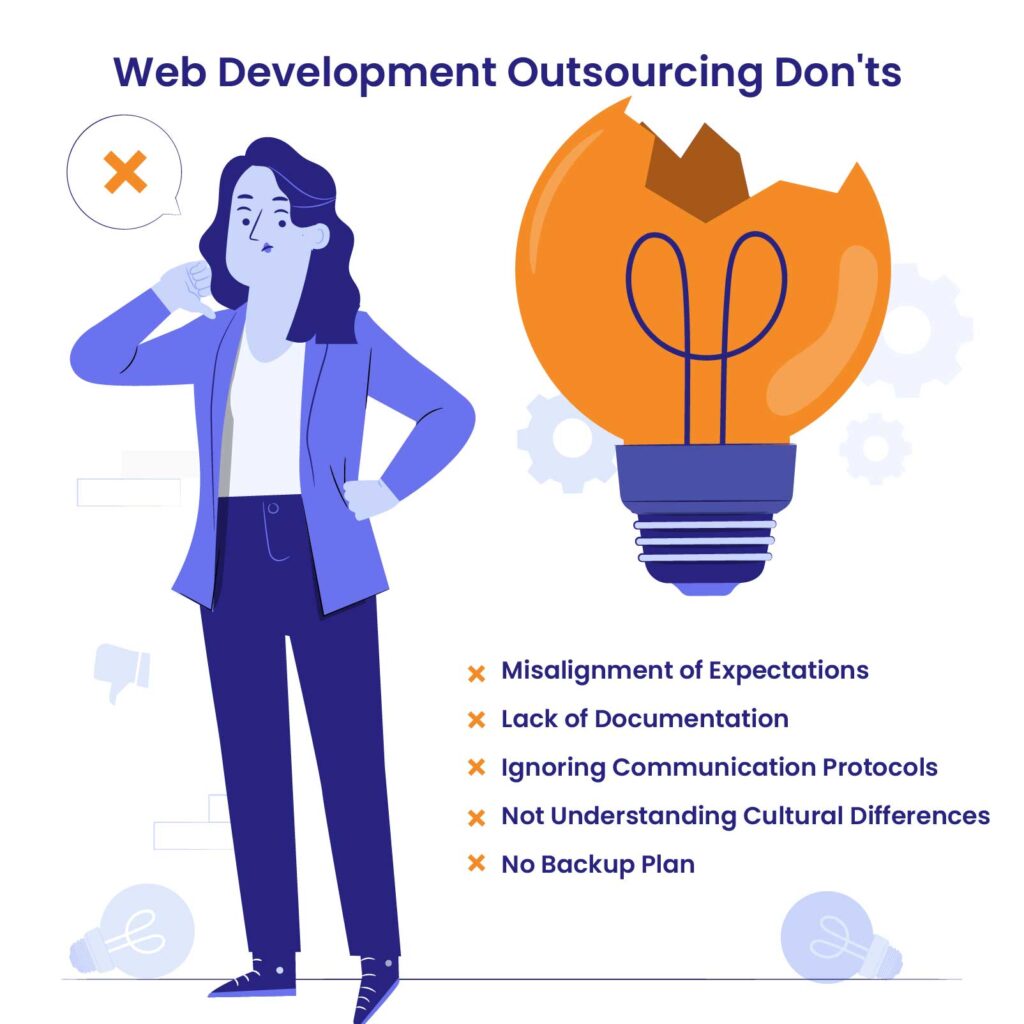
When you outsource web development or outsource web design, avoiding common pitfalls is essential to ensuring a successful project. Let’s take a look at frequent mistakes and explore strategies to help you steer clear of them.
Misalignment of Expectations
A common issue when you outsource web development or web design is the misalignment of expectations between your agency and the outsourcing partner. Misunderstandings about the project’s goals, scope, and deliverables can lead to dissatisfaction and delays. To avoid this, make sure both parties have a clear and shared understanding from the very beginning. Regular discussions and detailed documentation are key to keeping everyone on the same page.
Lack of Documentation
Insufficient documentation is a major risk when you outsource web development. Without comprehensive project briefs, technical specifications, and design guidelines, your outsourcing partner may struggle to fully understand your requirements, leading to mistakes and rework. Ensure that you provide detailed and clear documentation to guide the development process effectively.
Not Understanding Cultural Differences
When you outsource web development to an international partner, cultural differences can impact collaboration. As we noted above, misunderstandings may arise from different work cultures, communication styles, or problem-solving approaches. Taking the time to understand the cultural context of your outsourcing partner and fostering mutual respect can significantly improve project outcomes.
No Backup Plan
Having a contingency plan is vital when you outsource web design or development. Unexpected challenges, such as project delays or technical issues, can arise at any time. By preparing a robust backup plan—such as having an alternative partner ready or strategies to quickly address problems—you can ensure your project continues smoothly even if setbacks occur.
Case Studies and Success Stories

The decision to outsource web development can be a game-changer for your agency, but don’t just take our word for it. We’ve been in the business for a long time, and we’ve seen firsthand how it can propel agencies to new heights. To give you a better idea, we’re sharing a few case studies from our own experience at White Label Agency. These stories highlight how partnering with WLA has helped agencies grow, improve their client relations, and focus their energy on what they do best.
Challenge: As Rawcut Creative Company grew rapidly, they faced challenges in managing their increasing workload. The need to expand their service offerings without compromising on quality became a pressing issue.
Solution: By partnering with WLA for WordPress development, Rawcut was able to efficiently scale its operations. WLA provided a scalable development solution that allowed Rawcut to take on more complex projects without the need for costly in-house hires.
Outcome: This collaboration enabled Rawcut to expand its service offerings significantly and achieve substantial cost savings. WLA’s support not only streamlined their development process but also allowed them to position themselves as a comprehensive service provider, handling design, development, and maintenance for their clients.
Challenge: During the 2008 financial crisis, Site Mender faced the daunting task of reimagining its business model to survive the economic downturn. The agency needed to focus on maintaining client relationships while managing its workload efficiently.
Solution: Site Mender turned to WLA to outsource web development tasks. This strategic move allowed them to focus more on client engagement and the ongoing services that drive long-term value.
Outcome: By outsourcing non-core tasks to WLA, Site Mender was able to navigate the financial crisis successfully, sustaining its operations and enhancing client satisfaction. The approach they adopted, focusing on ongoing maintenance and smaller tasks, turned out to be a lucrative and sustainable strategy, reinforcing the importance of client-centric services.
Challenge: Whittier Advertising, led by Michael Hannuksela, was tasked with delivering high-impact marketing campaigns within tight budgets and timelines. The challenge was to balance the creative and technical aspects of each project while maintaining efficiency.
Solution: Whittier partnered with WLA to outsource web development, which allowed them to focus on the creative components of their projects. By leveraging WLA’s reliable and cost-effective development services, Whittier could optimize their time and budget effectively.
Outcome: The partnership with WLA enabled Whittier to consistently meet tight deadlines and exceed client expectations. By outsourcing development tasks, they optimized their operations, allowing them to deliver top-quality marketing initiatives while keeping costs under control.
Lessons Learned
- Scalability and Efficiency: Rawcut Creative Company’s success underscores the importance of partnering with a scalable outsourcing provider, enabling agencies to grow without overextending their internal teams.
- Client-Centric Focus: Site Mender’s experience illustrates that outsourcing non-core tasks can greatly enhance client relations, as it allows agencies to dedicate more time to client engagement and ongoing services.
- Optimization of Resources: Whittier Advertising’s story highlights the value of focusing on core competencies while outsourcing specialized tasks, leading to more impactful and timely project delivery.
Future Trends in Web Development Outsourcing

As we wrap up, let’s take a peek into the future of web development outsourcing. The landscape is always evolving, and staying ahead of the curve can give your agency a real edge.
AI and Automation
AI is increasingly transforming web development outsourcing by automating routine tasks and enhancing productivity. Future applications of AI in outsourcing may include advanced project management tools, AI-driven coding assistants, and automated quality assurance processes. Staying ahead of these trends can give your agency a competitive edge.
Cybersecurity
As cybersecurity becomes more critical in web development, ensuring the protection of client data will be a top priority. Best practices for maintaining security in outsourced projects include using encryption, secure communication channels, and regular security audits. With the rise of cyber threats, robust security measures will be essential for maintaining trust and compliance.
Remote and Distributed Teams
The trend towards remote and distributed teams is set to continue, driven by advancements in communication and collaboration technologies. Managing and collaborating with remote teams effectively will become a key skill for agencies that outsource web development. Embracing these trends will allow agencies to access global talent and operate more flexibly in a changing market.
Predictions for the Future
Experts predict that IT outsourcing will continue to grow, with increased emphasis on specialized skills, advanced technologies, and security. Agencies that prepare for these trends by adopting new technologies and focusing on quality will be well-positioned to thrive in the future.
Conclusion
Outsourcing web development services offers numerous benefits, including cost savings, access to expertise, scalability, and time efficiency. However, it also comes with challenges such as communication barriers, quality assurance, and data security. By carefully selecting the right outsourcing model and partner, and following best practices for managing the process, agencies can successfully outsource web development and achieve their strategic goals.
For agencies considering outsourcing, it’s crucial to clearly define the project scope, establish effective communication protocols, and choose a partner that aligns with your needs. Remember to consider the challenges and prepare to take them on with strong project management and risk mitigation strategies.
If you’re thinking of outsourcing web development, White Label Agency offers expert WordPress outsourcing services tailored to your needs. Our experienced teams are ready to help you achieve your project goals with high-quality, cost-effective solutions. Contact us today to discuss how we can support your agency’s growth.